Best AI for Logo Design? Ideogram vs Recraft vs Qwen
We tested Ideogram 4, Recraft V4.1, and Qwen Image 2.0 across 15 original logo designs to find the best AI logo generator for business.
The best AI for logo design in our test is Recraft V4.1. It won four of five first-run logo challenges and produced the most usable combination mark, typography-only wordmark, logo family, and monochrome scalability sheet. Qwen Image 2.0 finished second and won the real-world application test. Ideogram 4 placed third in this plain-prompt benchmark.
That answer comes from 15 new images, not vendor gallery examples. We wrote five original briefs based on an actual logo workflow: generating a symbol and wordmark, designing custom typography, building multiple lockups, checking one-color legibility, and applying a logo consistently across physical touchpoints. Each model received the same prompt once, and we kept the first successful output.
An important qualification: these models generated raster logo concepts. A visually successful result is not automatically finished brand artwork. Before using any AI-created logo commercially, redraw it as a clean vector, correct the letter spacing and geometry, test it at small sizes, and complete appropriate similarity and trademark reviews.
Best AI for logo design: results at a glance
| Logo-design test | Winner | What decided it |
|---|---|---|
| Symbol plus wordmark | Recraft V4.1 | Most complete, usable identity sheet |
| Typography-only wordmark | Recraft V4.1 | Exact spelling, strong kerning, and all three requested versions |
| Four-part logo family | Recraft V4.1 | Best horizontal, stacked, monogram, and app-icon system |
| Monochrome scalability | Recraft V4.1 | Cleanest repeated mark and strongest tiny-size silhouette |
| Real-world applications | Qwen Image 2.0 | Preserved the exact name across all three applications |
| Average generation time | Qwen Image 2.0, narrowly | 10.8 seconds versus 10.9 for Recraft and 30.8 for Ideogram |
Overall ranking: Recraft V4.1 scored 92.0/100, Qwen Image 2.0 scored 85.0, and Ideogram 4 scored 64.4. Recraft is our first choice for a designer who wants strong logo directions quickly. Qwen is a credible alternative when application consistency, speed, or open-weight deployment matters.
Try Recraft V4.1 or try Ideogram 4 directly on RenderFlow AI. You can also open the full image generator or compare plans and credits.
How we tested the AI logo generators
We generated all 15 examples on July 30, 2026 through RenderFlow AI. Each output was square and approximately 1024×1024 pixels. Within every test, the models received the identical original prompt and no reference image.
Our rules were:
- one first successful output per model and prompt;
- no aesthetic rerolls or cherry-picking;
- no vendor prompts, sample images, or existing logo templates;
- no editing, inpainting, typography repair, or manual retouching;
- WebP conversion and side-by-side layout as the only publication processing.
Every panel uses the same order: Ideogram 4 on the left, Recraft V4.1 in the middle, and Qwen Image 2.0 on the right. Click an image for a larger view. The prompts are included so you can reproduce the reasoning with another AI logo design tool.
We judged prompt adherence, exact wordmark accuracy, consistency when a symbol repeated, small-size usefulness, visual quality, and obvious artifacts. Because we generated only one image per condition, this is a test of first-run usefulness, not a statistical measure of every result a model can produce.
Test 1: Symbol and wordmark design
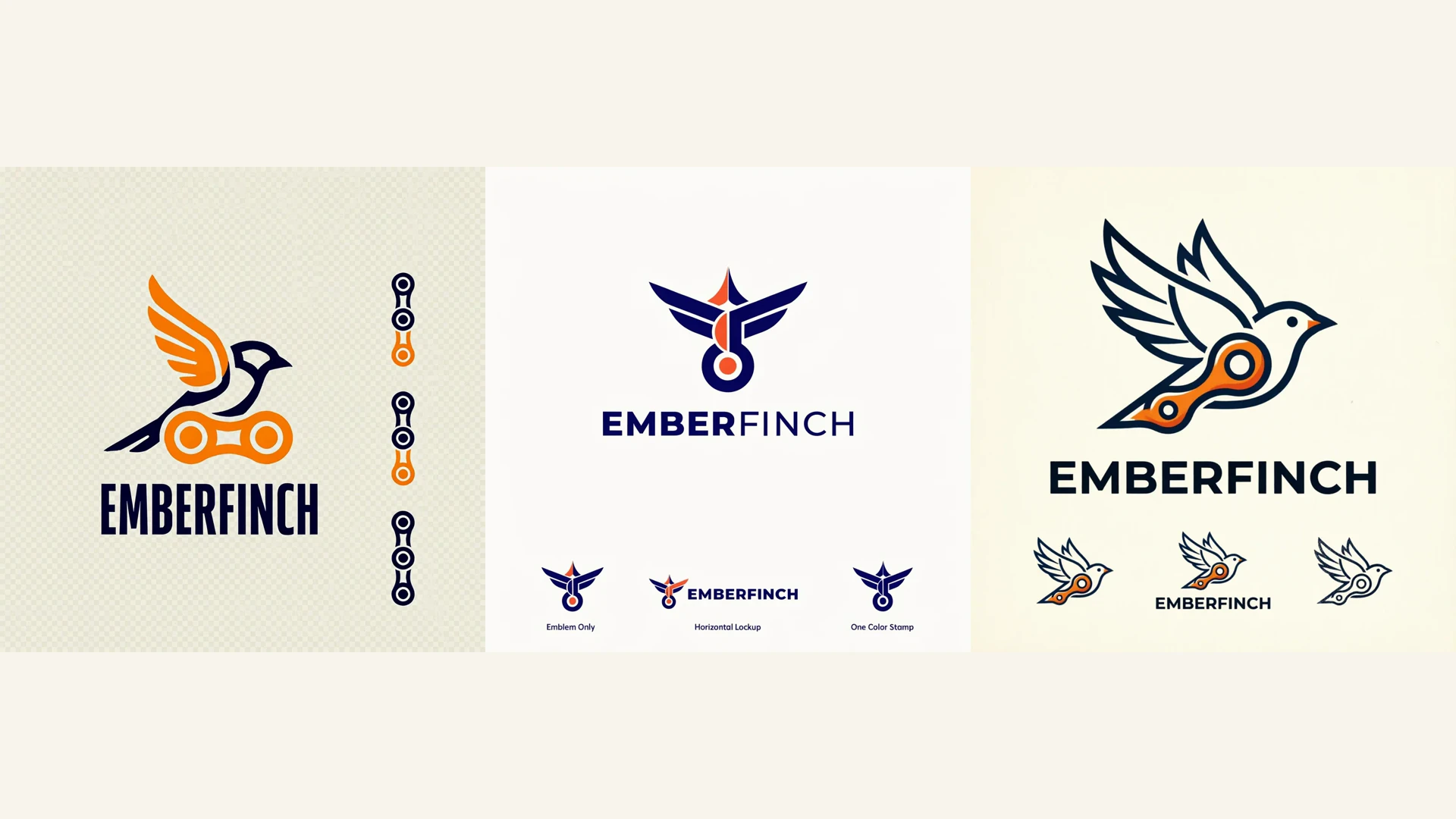
Left: Ideogram 4. Middle: Recraft V4.1. Right: Qwen Image 2.0.
The EMBERFINCH brief required a compact combination mark joining a finch wing with a bicycle chain link. It also asked for an exact wordmark and three smaller applications: emblem only, horizontal lockup, and a one-color stamp.
Recraft V4.1 delivered the most complete logo system. The emblem is compact, the wordmark is accurate, and the bottom row contains all three practical variations. It did add the captions “Emblem Only,” “Horizontal Lockup,” and “One Color Stamp,” violating the no-extra-words instruction. Nevertheless, its design would require the least reconstruction.
Qwen Image 2.0 made a bold, readable mark and showed three smaller forms, but used a full bird rather than the requested simplified wing. Ideogram 4 also favored a full bird, then replaced the three requested applications with a vertical row of chain-link symbols. Both are attractive concepts; neither is as useful as the requested identity sheet.
Winner: Recraft V4.1.
Exact combination-mark prompt
Create a clean vector-style identity sheet for the fictional coastal-cycling brand “EMBERFINCH”. Center one compact emblem combining a simplified finch wing with a bicycle chain link, with the exact wordmark “EMBERFINCH” directly below. Use only deep navy and signal orange on warm white. Include three smaller applications along the bottom: the emblem alone, the horizontal emblem-plus-wordmark lockup, and a one-color navy stamp. Flat fills, crisp geometry, balanced negative space, readable at thumbnail size. No gradients, shadows, mockups, birds with full bodies, extra symbols, extra words, spelling changes, or watermark.Test 2: Typography-only wordmark
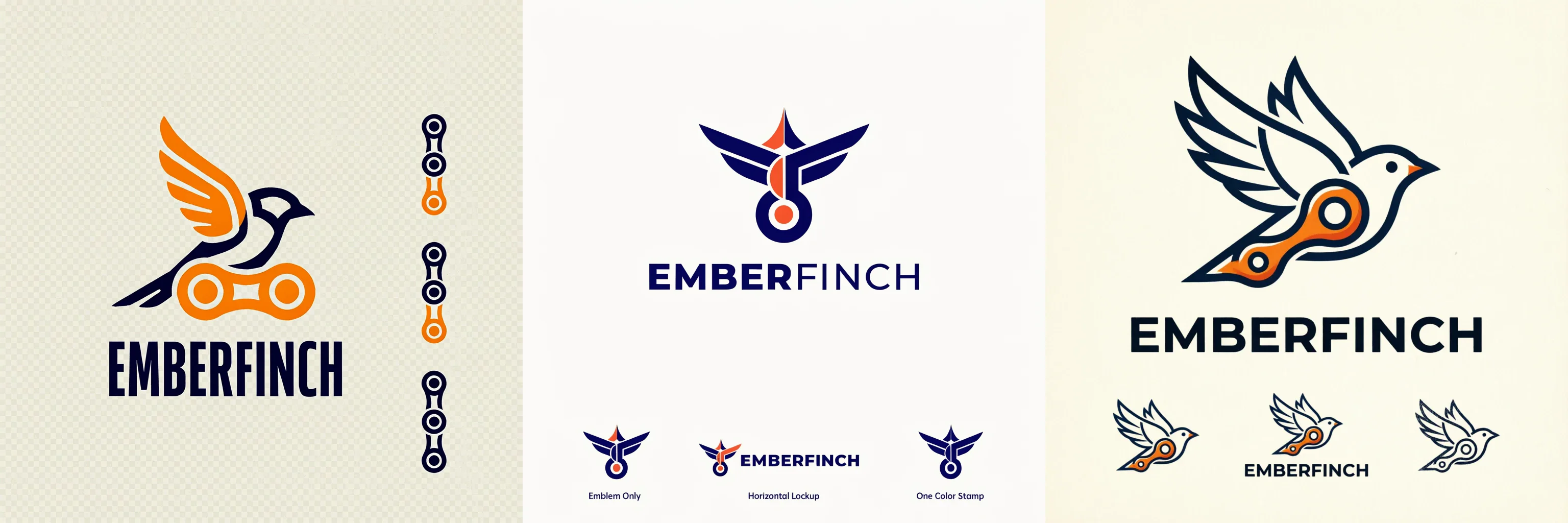
Left: Ideogram 4. Middle: Recraft V4.1. Right: Qwen Image 2.0.
This prompt prohibited a standalone icon and asked the models to solve the logo through custom lettering. Recraft produced the strongest primary wordmark and the two requested smaller versions. The spelling remains exact, the repeated geometry is consistent, and the stylized O still reads as part of VELLUMORBIT.
Qwen also spelled the name correctly in its smaller black and reversed versions. Its large treatment splits VELLUM and ORBIT over two lines, however, instead of creating the requested single centered wordmark. The result has editorial impact but changes the basic logo structure.
Ideogram fragmented the letters into several vertical and rotated compositions. Some small text remains readable, but there is no single dominant VELLUMORBIT wordmark matching the brief. This is a good example of why text rendering alone does not make a model a reliable AI logo generator for business: hierarchy and repeatability matter too.
Winner: Recraft V4.1.
Exact typography-logo prompt
Create a square typography-only logo exploration for the fictional editorial software brand “VELLUMORBIT”. Center one large custom all-caps wordmark spelling exactly “VELLUMORBIT”. Use a geometric sans-serif construction with generous spacing; make the circular O suggest an orbit only through its inner counter while remaining unmistakably the letter O. Below, show exactly two smaller versions of the identical wordmark: black on warm white at left and warm white reversed from a black rectangle at right. Crisp vector edges, optical kerning, readable at thumbnail size. Use only black and warm white. No standalone icon, planets, stars, taglines, extra letters, spelling changes, gradients, mockups, or watermark.Test 3: A complete logo family
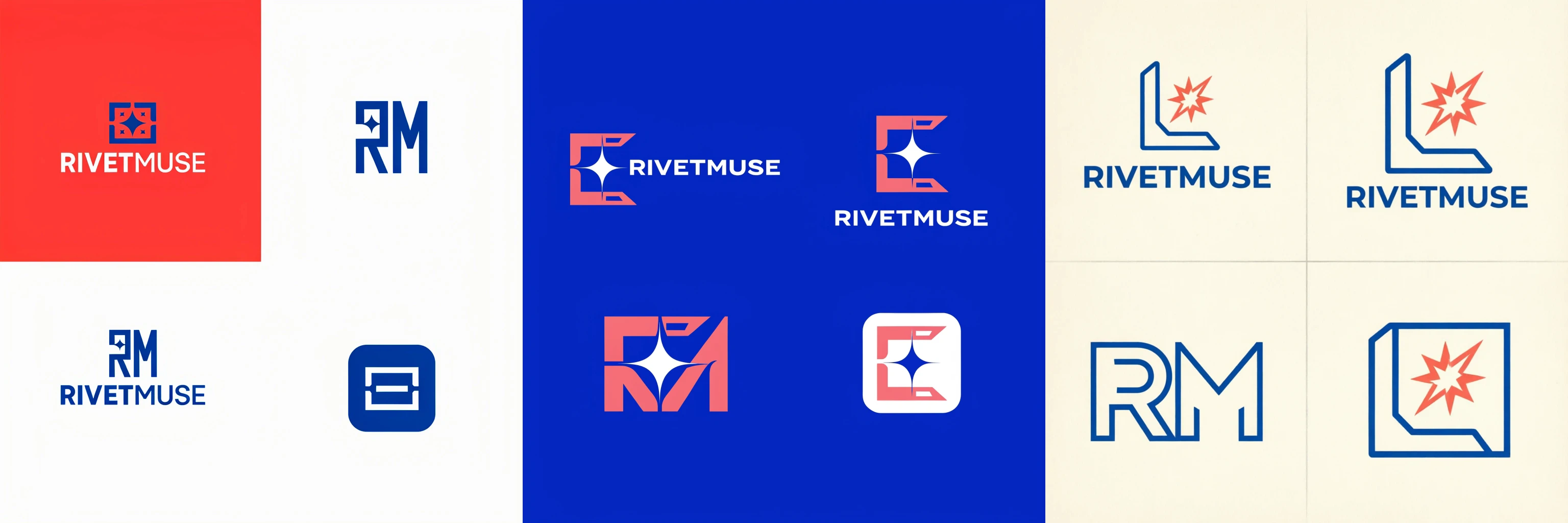
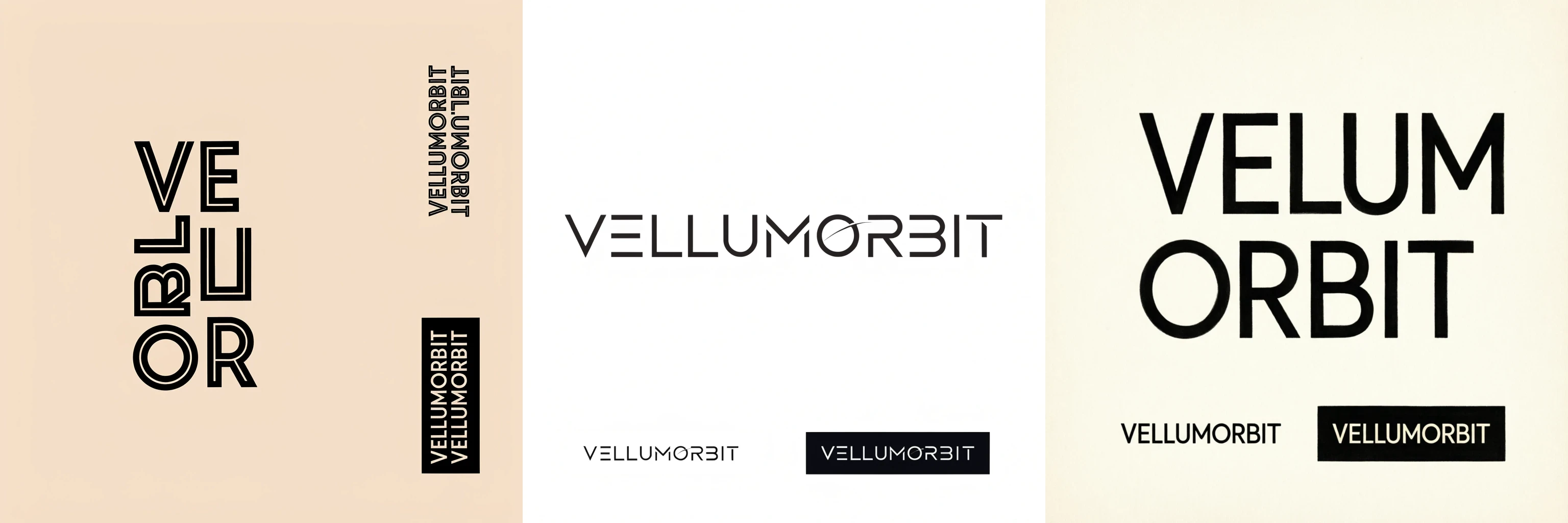
Left: Ideogram 4. Middle: Recraft V4.1. Right: Qwen Image 2.0.
A professional logo rarely exists in one arrangement. This RIVETMUSE brief asked for a horizontal lockup, a stacked lockup, an RM monogram, and a symbol-only app icon in an exact 2×2 grid.
Recraft understood the system. Its top-left logo is horizontal, the top-right version is stacked, the lower-left monogram derives from the same visual language, and the lower-right icon preserves the bracket-and-spark symbol. The cobalt and coral palette is also consistent throughout.
Qwen produced a clean four-cell board and a strong RM monogram, but both top-row versions place the symbol above the wordmark. It therefore omits the requested horizontal configuration. Ideogram included four cells and correct RIVETMUSE copy, yet its symbol geometry changes between the square emblem, RM forms, and app icon. That inconsistency increases the amount of designer cleanup required.
Winner: Recraft V4.1.
Exact logo-family prompt
Design a square vector identity sheet for the fictional creative-engineering studio “RIVETMUSE”. Build one distinctive symbol by joining a simple metal bracket shape with one four-point creative spark. Arrange exactly four logo lockups in an equal 2×2 grid: upper left horizontal symbol plus exact wordmark “RIVETMUSE”; upper right stacked symbol above the same wordmark; lower left an “RM” monogram derived from the same geometry; lower right a symbol-only square app icon. Keep the symbol geometry identical wherever it repeats. Use cobalt blue, bright coral, and warm white with flat fills and crisp edges. No captions, taglines, mockups, extra panels, gradients, shadows, spelling changes, or watermark.Test 4: Monochrome and small-size scalability
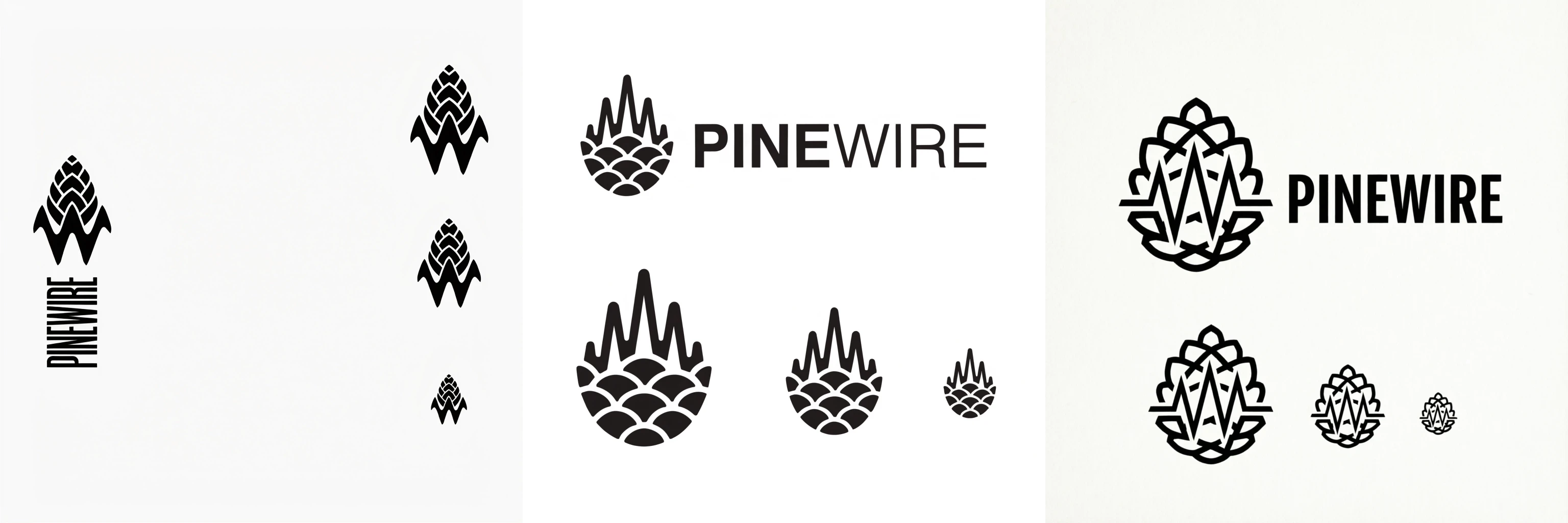
Left: Ideogram 4. Middle: Recraft V4.1. Right: Qwen Image 2.0.
Color and large presentation boards can hide weak logo construction. The PINEWIRE test removed those advantages. It required one black mark combining a pinecone and a three-peak waveform, an exact wordmark, and three identical symbol repetitions at descending sizes.
Recraft produced the simplest, most scalable silhouette. Its large horizontal lockup is clear, all three lower marks share the same geometry, and the tiny version retains the pinecone and waveform idea. Qwen followed the layout almost as well and kept the wordmark accurate, but its internal geometry contains more intersections and narrow spaces. Those details are more likely to close up in embroidery, engraving, or a small favicon.
Ideogram created an appealing emblem with consistent repeated forms, but rotated the main wordmark vertically and scattered the size examples rather than using the requested top-and-bottom hierarchy. It demonstrates a workable symbol direction, not the strongest production test sheet.
Winner: Recraft V4.1.
Exact monochrome-scalability prompt
Create a square black-and-white logo scalability sheet for the fictional outdoor-audio brand “PINEWIRE”. At the top, show one bold symbol combining the silhouette of a pinecone with a three-peak sound waveform, beside the exact uppercase wordmark “PINEWIRE”. Along the bottom, repeat only that identical symbol exactly three times at visibly descending sizes: large, medium, and tiny. The tiny version must remain recognizable through broad shapes and open negative space. Pure solid black on white, flat vector construction, consistent geometry, strong kerning. No gray, color, labels, size numbers, fine texture, extra icons, speakers, headphones, trees, taglines, spelling changes, or watermark.Test 5: Consistency across real-world applications
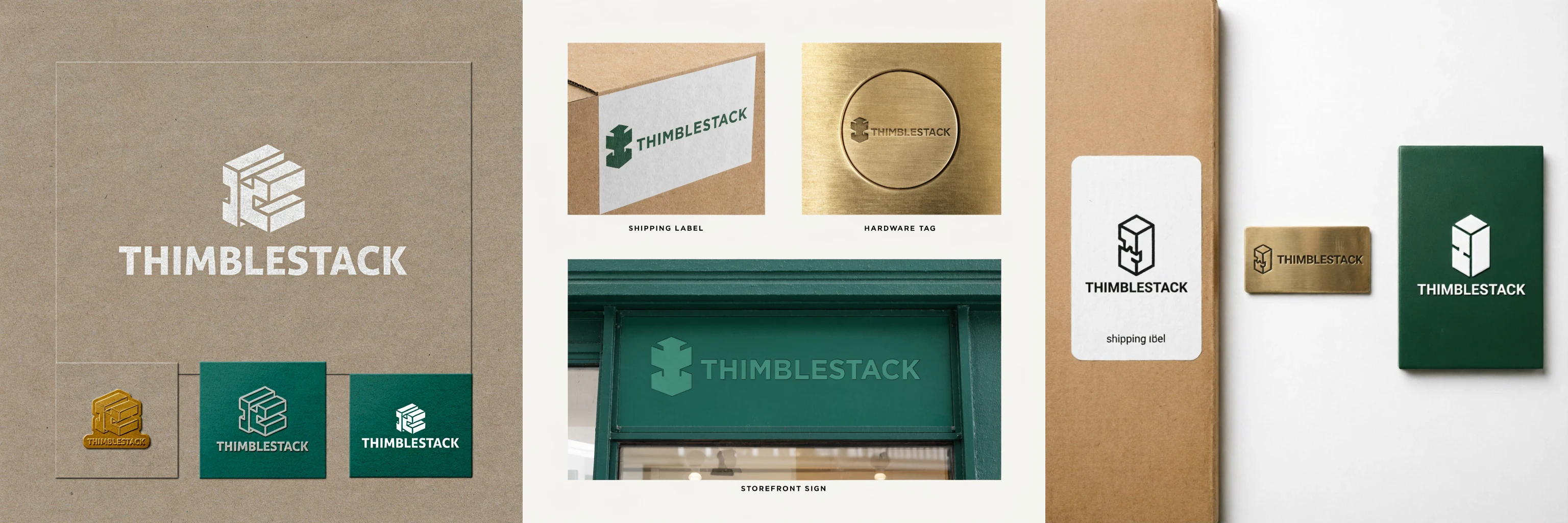
Left: Ideogram 4. Middle: Recraft V4.1. Right: Qwen Image 2.0.
The final brief tested whether one logo could survive three different material contexts: a shipping label, a debossed brass tag, and a dark-green storefront sign.
Qwen Image 2.0 was the only model to keep the exact THIMBLESTACK wordmark clearly readable across all three applications. It also preserved a recognizable stacked-joint symbol in black, brass, and white. The shipping label contains a small malformed phrase resembling “shipping label,” even though extra copy was forbidden, but the core brand remains consistent.
Recraft created the most polished presentation board and correctly separated the three applications. Its shipping and brass versions alter the wordmark to “THIMBLE STACK” and “THIMBL.ESTACK,” which is unacceptable for a final brand asset. Ideogram spelled the name correctly and rendered convincing materials, but showed more than the requested three applications and changed the symbol’s geometry across them.
Winner: Qwen Image 2.0.
Exact logo-application prompt
Create a square logo application board for the fictional modular-furniture company “THIMBLESTACK”. Design one compact abstract symbol combining a dovetail joint with three stacked blocks, paired with the exact uppercase wordmark “THIMBLESTACK”. Across exactly three applications, preserve the same symbol and wordmark geometry: a white shipping label on kraft cardboard, a small debossed brass hardware tag, and a dark-green storefront sign. Use forest green, brass, kraft brown, black, and white; premium practical art direction, realistic materials, straight-on presentation. No chairs, houses, hammers, trees, extra applications, taglines, invented copy, spelling changes, altered logos, or watermark.Overall logo-design scores
| Model | Symbol + type | Wordmark | Logo family | Scalability | Applications | Average |
|---|---|---|---|---|---|---|
| Recraft V4.1 | 89 | 96 | 95 | 96 | 84 | 92.0 |
| Qwen Image 2.0 | 75 | 82 | 86 | 90 | 92 | 85.0 |
| Ideogram 4 | 64 | 42 | 72 | 74 | 70 | 64.4 |
Recraft’s 4–1 win came from repeatable systems rather than one spectacular image. It handled exact names, lockup relationships, and small-size geometry more consistently. Qwen was a strong second across most categories and the only winner outside Recraft. Ideogram often contributed interesting art direction, but followed fewer of the requested presentation structures.
Speed, API cost, and paid-workflow value
Across the five first runs, average end-to-end generation time was 10.8 seconds for Qwen Image 2.0, 10.9 seconds for Recraft V4.1, and 30.8 seconds for Ideogram 4. Median times were 8.8, 10.9, and 25.0 seconds. Queue conditions, endpoints, and model updates can change these numbers, so treat them as dated observations rather than performance guarantees.
At publication:
- Ideogram 4 on RenderFlow AI is based on the Ideogram 4.0 release, a 9.3-billion- parameter open-weight model. Its hosted API page lists $0.03, $0.06, and $0.10 per image for Turbo, Default, and Quality tiers.
- Recraft V4.1 on RenderFlow AI follows the model documented in Recraft’s V4.1 guide, which emphasizes photorealism, illustration, and strong short-prompt results. Its API pricing lists V4.1 at $0.04 per image and V4.1 Pro at $0.25.
- The official Qwen Image repository describes Qwen Image 2.0 as an Apache-2.0 open-weight model with integrated generation and editing, stronger typography, and native 2K output. Hosted API pricing varies; self-hosting introduces infrastructure costs.
Per-image price is a small part of professional logo cost. The expensive step is human review: rejecting generic marks, correcting type, drawing clean vectors, defining clear space, preparing color variants, and checking whether a concept is safe to adopt. A cheap generation that creates hours of repair is not the cheapest workflow.
Which AI logo generator should you choose?
Choose Recraft V4.1 when you want the strongest first logo presentation, especially if your brief needs several lockups, exact wording, and a mark that must remain legible in one color.
Choose Qwen Image 2.0 when you want fast iterations, good application consistency, or an open-weight route. It is particularly competitive for showing a proposed identity on packaging and signage. Simplify intricate marks before treating them as production candidates.
Choose Ideogram 4 when your technical team values open weights and structured generation controls. This comparison used only ordinary text prompts; it did not test Ideogram’s JSON captions, bounding boxes, palette controls, custom training, or post-generation editing.
Whichever model you select, use AI for concept acceleration rather than a one-click final trademark. Write a specific brief, generate multiple directions, discard obvious category clichés, and have a designer rebuild the chosen route as an editable vector system.
For more prompt methodology, read our AI image prompt guide. You can also compare how current models handle broader commercial imagery in our GPT Image 2 vs Midjourney V8 test and Seedream 5 vs Nano Banana 2 benchmark.
Ready to explore your own identity brief? Start with Recraft V4.1 or Ideogram 4, or open RenderFlow AI’s image generator to compare the full model catalog.
Frequently Asked Questions
What is the best AI for logo design?
Recraft V4.1 was the best AI for logo design in our 15-image first-run benchmark. It won four of five tests: combination marks, typography-only wordmarks, multi-lockup systems, and monochrome scalability. Qwen Image 2.0 won the real-world application test.
Can an AI logo generator create a professional business logo?
An AI logo generator can produce useful concepts and presentation boards, but its raster output should not automatically become a final business logo. Redraw the selected concept as clean vector artwork, correct the typography and spacing, test it at multiple sizes, and complete appropriate similarity and trademark reviews before launch.
Is Recraft better than Ideogram for logo design?
Recraft V4.1 was substantially more reliable than Ideogram 4 in this plain-prompt benchmark. Recraft preserved wordmarks, layouts, and repeated geometry more consistently. Ideogram 4 remains relevant for custom workflows because it offers open weights and structured controls that we did not use in this text-to-image test.
Is Qwen Image 2.0 good for logo generation?
Yes. Qwen Image 2.0 finished second overall and produced the best three-application logo board. It was also roughly tied with Recraft for average generation speed. Its marks sometimes contained more detail than ideal for small sizes, so simplification and vector cleanup are still important.
How did you compare these AI logo generators?
We wrote five original commercial logo briefs and sent the same prompt once to Ideogram 4, Recraft V4.1, and Qwen Image 2.0. All 15 images were first successful runs at approximately 1024 by 1024 pixels. We used no reference images, rerolls, selective edits, or manual retouching.
Related Articles
GPT Image 2 vs Midjourney V8.1 & V8.2: 6-Prompt Test
We recreated six Midjourney V8.1 and V8.2 prompts with GPT Image 2. Compare realism, typography, prompt accuracy, API pricing, and business use.
14 min read
Seedream 5.0 Pro vs Nano Banana 2: Which AI Image Model Is Better?
We tested Seedream 5.0 Pro vs Nano Banana 2 with 16 original images. Compare quality, prompt accuracy, API price, speed, and best use cases.
12 min read
6 Best Free AI Image Generators in 2026 (No Credit Card)
Compare six free AI image generators by sign-up rules, credit limits, model choice, and upgrade path, including a local option without platform credits.
10 min read
About the Author
AI Image & Video Generation Experts