Seedream 5.0 Pro vs Nano Banana 2: Which AI Image Model Is Better?
We tested Seedream 5.0 Pro vs Nano Banana 2 with 16 original images. Compare quality, prompt accuracy, API price, speed, and best use cases.
Short answer: choose Seedream 5.0 Pro when polished product shots and campaign creative matter most. It won our product-photography and ad-design tests. Choose Nano Banana 2 when exact scene logic, speed, or 4K output matters more. It won the hardest spatial-instruction test and rendered about 5.5 times faster in this benchmark.
We reached that conclusion by generating 16 new images—not by comparing vendor showcase samples. Four original prompts tested product photography, ad typography, complex spatial instructions, and human realism. Each model received the same prompt twice at the same resolution and aspect ratio.
Naming note: we use “Seedream 5.0 Pro” for the tested model throughout, even though many searches shorten the name to “Seedream 5.0.” Model availability and labels can evolve, so check the current RenderFlow AI model page before generating.
Seedream 5.0 Pro vs Nano Banana 2 at a glance
| Category | Winner | What we found |
|---|---|---|
| Product photography | Seedream 5.0 Pro | More disciplined product staging and fewer unwanted label details |
| Ad typography | Seedream 5.0 Pro | Both spelled every required line correctly; Seedream looked more campaign-ready |
| Complex prompt adherence | Nano Banana 2 | More reliably rendered the requested crescent-moon reflection and spatial relationships |
| Human realism | Seedream 5.0 Pro, narrowly | Both produced believable hands; Seedream hit the exact shelf count in one run while Nano missed it twice |
| Generation speed as tested | Nano Banana 2 | 31.71-second mean versus 173.74 seconds |
| Maximum resolution available during the test | Nano Banana 2 | Up to 4K versus 2K |
Our verdict: Seedream 5.0 Pro is our choice for visually polished commercial creative. Nano Banana 2 is the better production choice for high-throughput work, strict multi-object instructions, and 4K delivery. The quality gap is small enough that the right choice depends on your workflow.
Open RenderFlow AI’s image generator to check the current model catalog, or compare plans and credits.
How we tested Seedream 5.0 Pro and Nano Banana 2
We generated every image on July 27, 2026 with RenderFlow AI’s image generator, using the Seedream 5.0 Pro and Nano Banana 2 models available during the benchmark.
Every comparison used:
- an original prompt written for this test;
- two independent generations per model;
- identical prompts and aspect ratios across models;
- 1K resolution and PNG generation output;
- no seed, reference image, vendor example prompt, web search, or image search;
- WebP publication assets converted at quality 90 with sharp YUV.
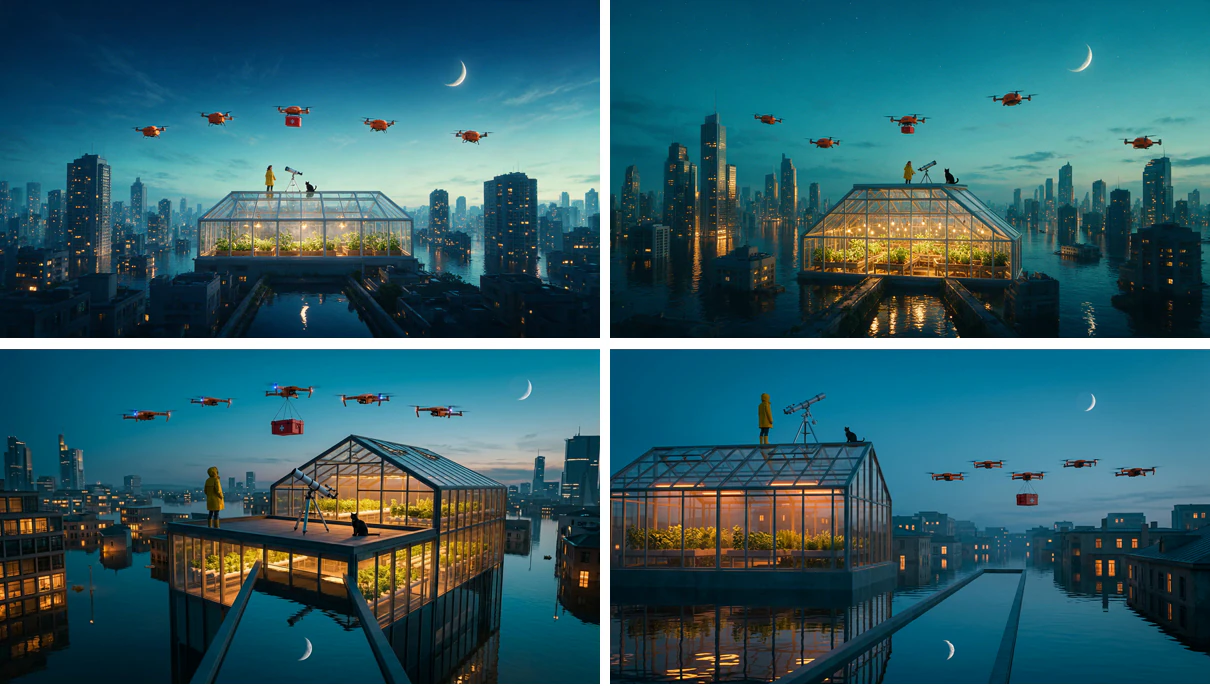
The endpoint PNG files were retained as audit masters, but every image displayed in this article is WebP. In each four-image panel, Seedream is the top row and Nano Banana 2 is the bottom row; runs 1 and 2 appear left to right.
This is a practical creative benchmark, not a statistically conclusive model evaluation. Two samples expose consistency problems that one hand-picked image can hide, but larger sample sizes may produce different rankings.
Test 1: Product photography and material realism

Top: Seedream 5.0 Pro runs 1–2. Bottom: Nano Banana 2 runs 1–2.
The prompt asked for one fictional AURELIS aroma diffuser, a cobalt glass ring, and exactly three accessories in fixed positions. It also required the two-line label “AURELIS / Quiet Atmosphere” and prohibited extra text.
Both models produced convincing glass, ceramic, copper, and travertine. Nano Banana 2 rendered the requested product label clearly, but introduced unrequested micro-copy on the instruction card or refill vial in both runs. That matters for a commercial product shot: plausible-looking invented copy still requires retouching.
Seedream kept the supporting objects cleaner and gave both images a more controlled luxury-campaign look. Its vial changed from a capped bottle to a dropper-style bottle in one sample, but the overall staging remained closer to the brief.
Winner: Seedream 5.0 Pro.
Exact product-photography prompt
Create a premium vertical studio product photograph for the entirely fictional consumer-tech brand AURELIS. Show exactly one matte-ivory smart aroma diffuser, shaped like a low rounded cylinder, centered at a three-quarter angle on a pale travertine plinth. A translucent cobalt-blue glass ring wraps around its upper third, with physically accurate refraction and subtle condensation. Include exactly three accessories: a small copper measuring spoon lying to the left of the plinth, one sealed amber refill vial standing behind the diffuser on the right, and one folded off-white instruction card at the front-right edge. The diffuser label must read exactly “AURELIS” on the first line and “Quiet Atmosphere” on the second line. Soft warm key light from upper left, cool rim light from right, realistic micro-scratches, restrained luxury styling, shallow depth of field, no hands, no duplicate products, no extra accessories, no extra text, no watermark.Test 2: Ad typography and paid-social layout

Top: Seedream 5.0 Pro runs 1–2. Bottom: Nano Banana 2 runs 1–2.
This test required four exact pieces of copy, a fixed visual hierarchy, a coral CTA button, and translucent paper forms in the lower-right quadrant.
The most important result is that both models spelled all specified copy correctly in both runs. That includes the brand name, price, punctuation, capitalization, and CTA. This is a substantial improvement over the malformed lettering often associated with older image generators.
Nano Banana 2 created clean, usable layouts, although its first run moved the paper forms toward the lower center and felt more like an early design concept. Seedream adhered more closely to the requested art direction and produced the more finished paid-social creative in both runs.
Winner: Seedream 5.0 Pro. Nano Banana 2 remains a strong choice when clean typography matters more than decorative art direction.
Exact ad-typography prompt
Design a polished vertical paid-social advertisement for the entirely fictional subscription service NORTHSTAR STUDIO. Use a deep midnight-blue background, electric-coral accents, generous negative space, and a cluster of elegant translucent 3D paper forms in the lower-right quadrant. Typeset only the following copy, preserving spelling, capitalization, punctuation, and hierarchy exactly: large headline “MAKE IDEAS VISIBLE”; smaller subhead “Product visuals in minutes.”; price line “$29 / month”; coral rounded CTA button “START CREATING”. Place a small four-point star icon beside NORTHSTAR STUDIO at the top, but do not repeat the brand name elsewhere. Crisp professional art direction, precise alignment, accessible contrast, realistic soft shadows, no people, no mock device frame, no extra words, no malformed letters, no watermark.Test 3: Complex spatial instructions and object counting
Top: Seedream 5.0 Pro runs 1–2. Bottom: Nano Banana 2 runs 1–2.
This was the hardest logic test. The scene required exactly five drones in an arc, a red medical crate under only the middle drone, a botanist to the left of a telescope, a cat to its right, and a crescent moon reflected once in a lower water channel.
Both models created coherent, cinematic flooded cities and got the major left-middle-right relationships right. Seedream’s two scenes were especially strong as concept art. However, its water reflection read as general moonlight rather than the requested crescent shape.
Nano Banana 2 made the crescent reflection explicit in both runs while preserving the drone arc and rooftop arrangement. Its compositions were a little less sweeping, but its literal instruction following was better.
Winner: Nano Banana 2.
Exact spatial-composition prompt
Create a wide cinematic concept image at blue hour: a glass rooftop greenhouse rises above a quietly flooded near-future city. Exactly five compact orange rescue drones fly in a shallow horizontal arc from left to right; only the middle drone carries a single red medical crate beneath it, while the other four carry nothing. On the greenhouse roof, place a botanist in a yellow raincoat to the left of a silver telescope and a black cat sitting to the right of the telescope. Inside the greenhouse, warm lamps illuminate rows of green herbs. A thin crescent moon appears in the upper-right sky and is reflected once in a narrow water channel at the lower center. Wide 24 mm viewpoint, believable scale, coherent reflections and atmospheric perspective, orange-versus-teal color separation, no additional drones, no other people or animals, no text, no watermark.Test 4: Human realism, hands, and editorial detail

Top: Seedream 5.0 Pro runs 1–2. Bottom: Nano Banana 2 runs 1–2.
We asked for a fictional ceramicist holding a faceted blue vase with one hand and painting one gold line with the other. Both hands had to remain visible and anatomically believable. The background also required exactly seven cups: four above and three below.
Both models handled the hands, brush grip, skin texture, and workshop lighting well. Neither produced the obvious extra-finger artifacts that would make an image unusable.
Counting was harder. Seedream’s first run showed too many cups, but its second run hit the requested four-plus-three arrangement exactly and included the mirror reflection. Nano Banana 2 rendered six shelf cups in both samples. Its portraits were highly convincing, but the repeated counting miss gives Seedream the narrow edge.
Winner: Seedream 5.0 Pro, narrowly.
Exact human-realism prompt
Create a vertical editorial lifestyle photograph of Mina Ortega, an entirely fictional ceramic artist in her mid-fifties, working in a sunlit neighborhood pottery studio. She has silver-streaked black hair tied loosely back and wears a charcoal linen apron over a rust-colored shirt. Her left hand steadies one faceted cobalt-blue vase on a stationary pottery wheel; her right hand uses a fine brush to apply one thin gold line around the vase. Both hands must be fully visible with natural anatomy and believable grip. Behind her, show exactly seven finished cups on a wooden shelf, arranged as four on the upper shelf and three on the lower shelf. A wall mirror reflects one tall window but does not show the camera or a second person. Natural skin pores, small clay-dust marks, soft late-afternoon window light, documentary realism, authentic workshop clutter, no jewelry, no extra hands or fingers, no text, no watermark.Seedream 5.0 Pro vs Nano Banana 2: speed and resolution
Image quality was close. The production differences were not.
| Benchmark factor | Seedream 5.0 Pro | Nano Banana 2 |
|---|---|---|
| Mean reported inference time | 173.74 sec | 31.71 sec |
| Median reported inference time | 179.02 sec | 22.62 sec |
| Range across eight calls | 148.26–188.93 sec | 15.72–52.81 sec |
| Highest resolution available during test | 2K | 4K |
| Web/image search controls available during test | No | Yes |
Nano Banana 2 had an average inference time about 5.5 times shorter. That does not make it universally more efficient: a slower generation that requires less retouching may be the better deal, while a faster model can be worth more in an interactive design workflow. Queue conditions, model updates, and output resolution can also change. Treat these as dated benchmark observations, not service guarantees.
RenderFlow AI shows the current credit requirement before generation. Compare the live settings on the Seedream 5.0 model page, the Nano Banana 2 model page, or the AI image generator before starting a large batch.
Google’s own documentation describes Nano Banana 2 as Gemini 3.1 Flash Image, with 4K output, improved text rendering, world knowledge, and multi-reference consistency. See the official Nano Banana 2 announcement and Gemini image-generation documentation.
ByteDance’s first-party model site documents the Seedream 5.0 family. Because model labels and platform controls can change, use the current RenderFlow AI interface—not an old benchmark table—to confirm the settings available today.
Which model should you choose?
Choose Seedream 5.0 Pro for:
- premium product photography and material-focused concepts;
- polished ad creative that should look close to campaign-ready;
- visual exploration where waiting a few minutes is acceptable.
Choose Nano Banana 2 for:
- rapid iteration and high-throughput generation;
- scenes with many explicit spatial relationships;
- workflows that need 4K output from the tested endpoint;
- applications that can benefit from exposed web or image-search controls.
For a marketing team, a practical workflow is to use Nano Banana 2 to explore many directions quickly, then compare the strongest idea with Seedream 5.0 Pro when final art direction and product polish matter most.
Final verdict
In our Seedream 5.0 Pro vs Nano Banana 2 comparison, Seedream 5.0 Pro won three of four visual tests and delivered the stronger commercial aesthetic. Nano Banana 2 was the clear speed winner and followed the hardest spatial prompt more precisely.
If you only want one default for product visuals and paid ads, start with Seedream 5.0 Pro. If turnaround time, 4K output, or complex instruction following is the constraint, start with Nano Banana 2.
Try the current image models in RenderFlow AI and compare the credit cost before generating.
Frequently Asked Questions
Is Seedream 5.0 Pro better than Nano Banana 2?
Seedream 5.0 Pro was better for product photography, ad art direction, and the human-realism prompt in our 16-image benchmark. Nano Banana 2 was better at the most complex spatial prompt and was much faster. The better choice depends on whether you prioritize final-image polish or production speed and literal instruction following.
How much does Nano Banana 2 cost?
RenderFlow AI displays the current Nano Banana 2 credit cost before generation. Required credits can vary with resolution and product updates, so check the Nano Banana 2 model page before running a large batch.
Does Seedream 5 have an API?
Seedream 5 is available through model APIs and browser-based generation platforms. We created the images in this benchmark through RenderFlow AI, where users can select Seedream 5.0, configure the image, and see the required credits before generating.
Which model is better for commercial marketing images?
Seedream 5.0 Pro is our first choice for product hero images and polished ad creative. Nano Banana 2 is attractive when a team needs many fast iterations, 4K delivery, or tight control over complex scene instructions. Always review generated copy, logos, product geometry, and current usage terms before publishing client work.
Related Articles
GPT Image 2 vs Midjourney V8.1 & V8.2: 6-Prompt Test
We recreated six Midjourney V8.1 and V8.2 prompts with GPT Image 2. Compare realism, typography, prompt accuracy, API pricing, and business use.
14 min read
Best Stable Diffusion Alternatives in 2026: Cloud-Based AI Image Generators
Looking for Stable Diffusion alternatives that don't require a GPU? Compare the best cloud-based AI image generators including RenderFlow AI, Midjourney, and more.
10 min read
Best Midjourney Alternatives 2026: Browser-Based AI Image Generators
Compare the best Midjourney alternatives for 2026, including browser-based AI image generators with free tiers, commercial use, pricing, and model variety.
8 min read
About the Author
AI Image & Video Generation Experts