100+ AI Image Prompts: Real Examples, Tests, and Better Results
Copy 100+ AI image prompts and study seven real prompt tests recreated with GPT Image 2, Nano Banana 2, and Seedream 5, with practical tips for better results.
Need AI image prompts you can copy, tweak, and run immediately? This guide includes 100+ prompt examples for portraits, product photos, logos, anime, photorealistic scenes, social media graphics, and more. It also includes seven prompts shared by creators on X, their original posted images, and our own reruns through RenderFlow AI.
The comparisons reveal something a list of attractive prompts cannot: which instructions actually control the image, which details a model may ignore, and how the same words can lead to a different but still successful composition.
Understanding AI Image Prompts
AI image prompts are text descriptions that instruct artificial intelligence to generate specific images. Think of them as detailed instructions to an incredibly skilled artist who can create anything you describe—but only if you communicate clearly and effectively.
The key to successful text-to-image prompts lies in understanding how AI models interpret language and translate words into visual elements. Every word matters, from the subject and setting to technical details like lighting and composition.
Why Prompt Quality Matters
The difference between a mediocre and exceptional AI-generated image often comes down to prompt crafting:
- Specific prompts produce focused, high-quality results
- Vague descriptions lead to unpredictable or generic outputs
- Technical terms can significantly improve image quality
- Style references help achieve consistent aesthetic goals
Essential Elements of Effective AI Art Prompts
Before diving into examples, let’s understand the core components of successful AI image prompts:
1. Subject Description
The main focus of your image should be clearly defined:
- What: Person, animal, object, concept
- Who: Specific characteristics, age, appearance
- How many: Quantity and arrangement
2. Visual Details
Descriptive elements that enhance the subject:
- Physical appearance: Colors, textures, materials
- Expressions and poses: Facial expressions, body language
- Clothing and accessories: Style, color, era
3. Setting and Environment
Context that surrounds your subject:
- Location: Indoor, outdoor, specific places
- Time of day: Morning, sunset, night
- Weather and atmosphere: Sunny, rainy, foggy
4. Style and Artistic Direction
Technical and aesthetic specifications:
- Art style: Photography, painting, digital art
- Color palette: Monochrome, vibrant, pastel
- Mood and tone: Happy, mysterious, dramatic
5. Technical Parameters
Camera and quality specifications:
- Camera details: Lens type, aperture, focal length
- Quality terms: High resolution, sharp focus, detailed
- Composition: Rule of thirds, symmetrical, close-up
7 Real AI Image Prompts, Recreated and Compared
The examples below come from public posts by AI creators on X. We preserved each prompt’s wording and compared the creator’s posted image with a fresh image generated through RenderFlow AI’s image generator. Six tests use the same model named in the original post. The final Midjourney prompt uses Seedream 5 as a cross-model test because Midjourney is not currently available on RenderFlow AI.
These are not attempts to reproduce the same pixels. Image generation includes randomness, so even identical prompts and model versions can produce different people, framing, and small details. We assessed four things instead:
- Prompt adherence: Did the result include the requested subjects, setting, clothing, and action?
- Composition: Did the model organize the scene clearly and preserve the intended camera angle?
- Style fidelity: Did lighting, texture, color, and mood match the art direction?
- Unwanted inventions: Did the model add people, brands, objects, or text that the prompt never requested?
Each comparison image is labeled, opens in a larger view when clicked, and is served as WebP from our image CDN.
1. Retro Fashion Editorial: Detailed Direction Without Losing the Mood
Prompt and original image shared by @vireonixx. We reran it with Nano Banana 2 on RenderFlow AI.
Create a high-end fashion editorial photograph inspired by retro film photography and contemporary outdoor lifestyle editorials. Capture a calm, thoughtful young woman in her early 20s with a slim build, fair skin with neutral undertones, an oval face, softly defined jawline, subtle cheekbones, a straight nose, natural lips with a muted coral tint, and straight dark eyebrows. She has smooth, shoulder-length dark brown hair styled in a center-parted straight bob tucked neatly behind her ears. Her expression is focused, with a slightly intense gaze directed over the top of the paperback book she is reading.

Dress her in an oversized black cardigan layered over a crisp white button-up shirt, paired with high-waisted brown wide-leg trousers secured with a black belt. Complete the look with large silver over-ear headphones and amber-tinted rectangular sunglasses, creating a minimal academic aesthetic with strong vintage influences. She is lying comfortably on a lush green park lawn, viewed from a high-angle top-down perspective. One hand holds the open paperback book while the other gently adjusts her headphones. Her head is slightly raised toward the camera, giving the composition a relaxed yet artistic editorial feel.

The entire frame is filled with vibrant green grass, creating a clean and minimal outdoor setting. Shoot during daytime using soft natural sunlight from overhead, producing gentle directional shadows and a warm nostalgic atmosphere. Use a moderately shallow depth of field with subtle softness around the edges while maintaining sharp focus on the subject. Frame the image as a medium full-body portrait from directly above, combining crisp central detail with authentic vintage softness.

Apply cinematic analog-inspired color grading with realistic film grain, rich olive green, black, white, and dark brown tones accented by warm amber highlights, silver metallic details, and natural skin tones. The final image should resemble a premium retro fashion editorial, blending timeless film photography, quiet intellectual style, outdoor reading, minimal fashion, and nostalgic analog aesthetics in a refined, artistic composition.
Why this is a good prompt: It is long, but it has a clear hierarchy. It defines the subject, wardrobe, pose, camera position, environment, light, palette, and finish in separate blocks. Details such as “one hand holds the open paperback” and “the other gently adjusts her headphones” make the pose testable rather than merely atmospheric. The repeated retro-editorial direction keeps the many individual details stylistically coherent.
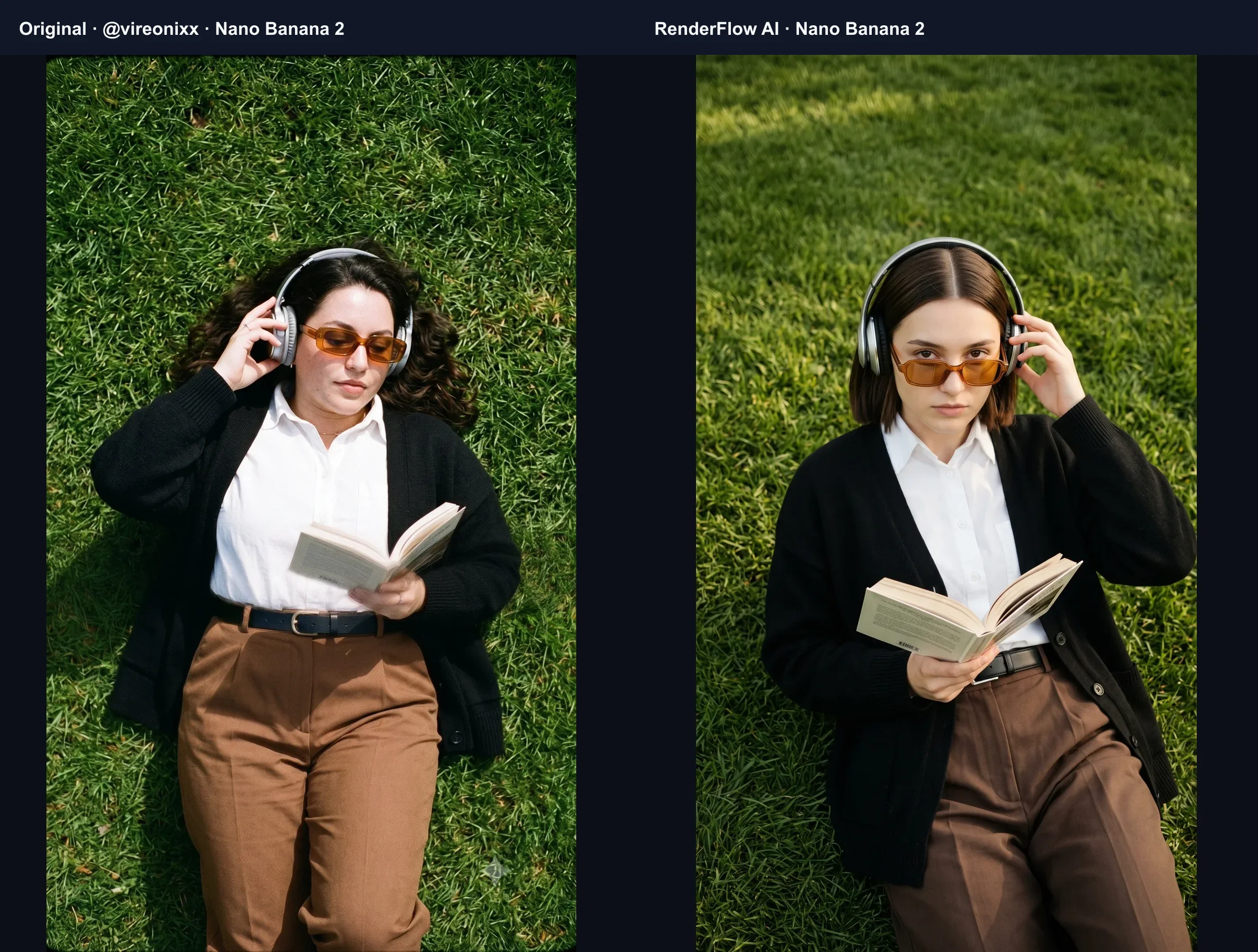
What happened: The original has a candid, film-like softness and interprets the woman with curlier hair, despite the prompt asking for a straight center-parted bob. Our result follows the written attributes more literally: straight bob, full outfit, amber glasses, headphones, book, top-down framing, and the hand adjusting the headphones. It is cleaner and more controlled, although that precision also makes it feel slightly more staged than the original.
Lesson: Use this block-by-block structure when a campaign needs wardrobe and pose consistency. If authentic spontaneity matters more than literal compliance, loosen a few appearance details and emphasize candid timing, imperfect posture, or documentary framing.
2. Moonlit Fantasy River: Strong Palette and Visual Anchors
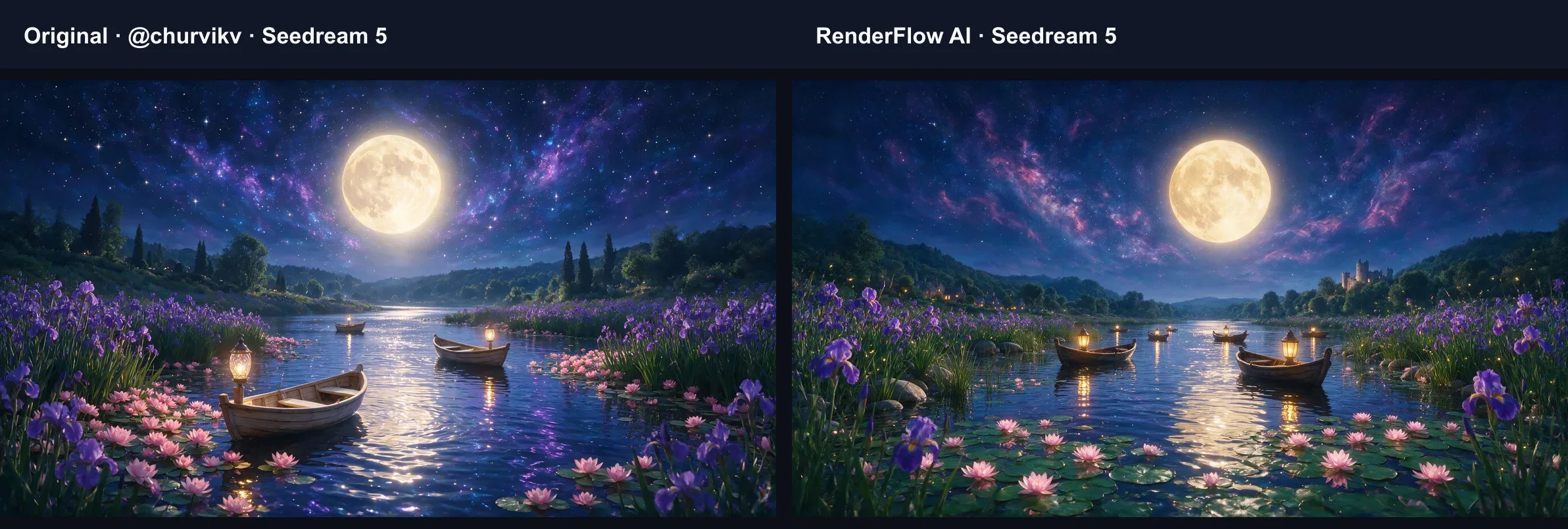
Prompt and original image shared by @churvikv. We reran it with Seedream 5 on RenderFlow AI.
A magical, dreamlike night scene featuring a serene river lined with vibrant purple irises and pink water lilies, illuminated by a large glowing full moon in a swirling, star-filled sky. Several small wooden boats float on the water, each holding a softly glowing lantern, casting reflections across the rippling surface. The composition is lush and immersive, with rich, saturated colors and a whimsical, enchanting mood that evokes a sense of tranquility and wonder.Why this is a good prompt: Every sentence performs a different job. The first establishes the scene and dominant colors, the second adds foreground and midground storytelling objects, and the third unifies the image with mood and saturation. The moon, river, boats, flowers, and lantern reflections act as visual anchors, giving the model freedom without leaving the composition undefined.
What happened: Both images closely match the core scene and purple-blue palette. The original creates stronger near-to-far depth with a prominent foreground boat and a more asymmetrical path into the distance. Our result is more centered and distributes more small lantern boats across the water, while separating the irises and water lilies clearly. Both preserve the moonlight, reflections, and tranquil fantasy mood.
Lesson: A compact prompt can outperform a much longer one when it names a few unmistakable objects and connects them through light. To control the layout further, add a phrase such as “one large boat in the lower-left foreground, smaller boats receding toward the moon.”
3. Chinese Ink-Wash Landscape: Medium, Atmosphere, and Negative Space
Prompt and original image shared by @churvikv. We reran it with Seedream 5 on RenderFlow AI.
A breathtaking landscape in the style of traditional Chinese ink wash painting, featuring a majestic wooden pagoda perched precariously on a sheer, jagged cliffside. The scene is enveloped in a sea of soft white clouds and rolling mist that flows between towering mountain peaks. Frosted white trees and delicate pine branches frame the composition, their needles dusted with snow. The color palette is composed of cool blues, soft teals, and muted greys, with a faint warm glow on the horizon suggesting a winter sunrise. The mood is serene, ethereal, and contemplative, emphasizing the vastness of nature and the solitude of the mountain retreat.Why this is a good prompt: It names an artistic medium, then supports that direction with subjects and atmospheric devices that belong to it: mist, sparse branches, layered mountains, muted color, and contemplative scale. “A faint warm glow” provides a restrained color contrast instead of fighting the cool palette. The wording also gives the model natural places to preserve negative space.
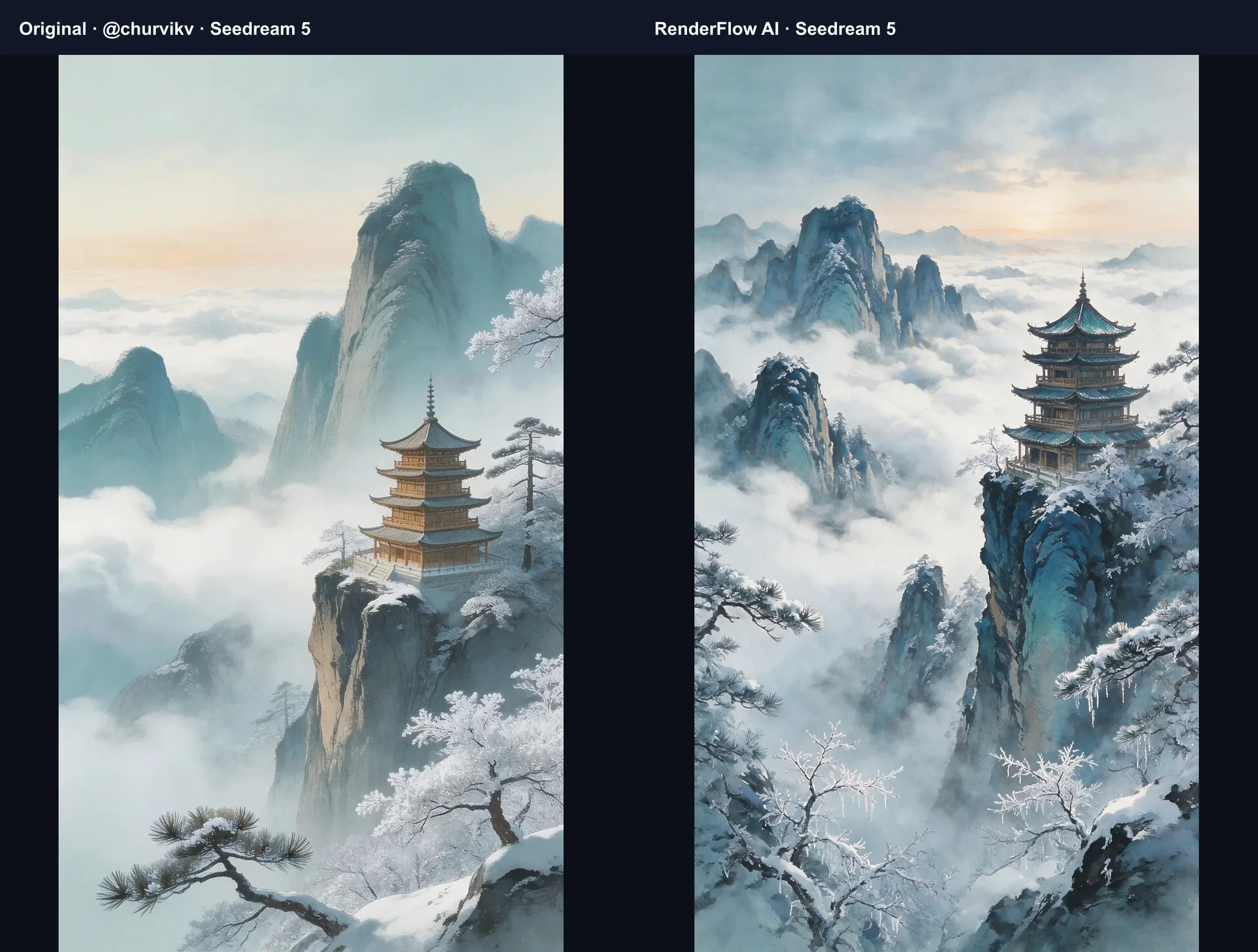
What happened: The original is softer and more minimal, with wider quiet areas, a solitary pagoda, and mist that feels close to restrained ink wash. Our result increases the cliff texture, architectural detail, mountain depth, and warmth at the horizon. It is more dramatic and information-rich, but somewhat less sparse than the source image.
Lesson: Naming a traditional medium is not always enough to control its restraint. If negative space is essential, add direct limits such as “minimal brushwork,” “large areas of untouched paper,” and “avoid dense micro-detail.”
4. Expressive Graphite Portrait: Excellent Style Control, Missing Subject Control
Prompt and original image shared by @aatif_j. We reran it with GPT Image 2 on RenderFlow AI.
A highly expressive graphite pencil portrait on textured fine art drawing paper, 4:5 aspect ratio. Create the drawing with approximately 85-90% completion, intentionally leaving unfinished passages, open contours, construction lines, and visible artistic decisions. The portrait should feel like a museum-quality graphite study rather than a fully rendered illustration. Use extremely rich, deep graphite blacks with dramatic tonal contrast. Build powerful black focal points using heavy 8B-14B graphite, creating bold shadow masses that immediately attract the viewer's eye. The darkest values should feel dense, velvety, and tactile without appearing digitally crushed.

Instead of rendering every detail equally, selectively emphasize only the most expressive features of the face - especially the eyes, eyebrows, nose bridge, beard texture, hairline, and facial structure. Allow these key areas to receive the highest level of detail and contrast. The remaining areas should gradually dissolve into loose graphite marks, incomplete shading, broken contours, and unfinished forms, with less than 80% rendering. Large areas of the portrait should intentionally remain suggested rather than fully described, allowing negative space and the viewer's imagination to complete the image.

Use confident, energetic pencil strokes with natural variation in pressure. Build form through layered graphite, cross-hatching, feathered shading, irregular line work, and spontaneous sketch gestures. Visible graphite powder should softly spread across the paper, producing subtle atmospheric transitions without becoming overly blended. Include realistic graphite grain, charcoal-like dust, accidental smudges, erased highlights, paper fibers, dirty whites, and authentic hand-drawn imperfections. Hair should be rendered with expressive overlapping strokes that alternate between razor-sharp strands and loose graphite masses. Facial hair should appear organic, rough, and richly textured using layered broken graphite marks instead of smooth rendering.

Maintain a dramatic high-contrast lighting setup. Define the portrait primarily through tonal masses rather than outlines. Deep blacks should anchor the composition while soft midtones gradually disappear into unfinished paper texture. The overall tonal mood should resemble a traditional academic graphite master drawing using cool neutral graphite tones with rich charcoal blacks and warm paper highlights. Avoid flat gray rendering. Preserve strong black accents and crisp value separation throughout the composition.

Traditional graphite drawing, museum-quality pencil art, expressive realism, selective rendering, dramatic chiaroscuro, powerful black focal points, authentic graphite texture, tactile paper surface, unfinished artistic process, handmade appearance, fine art sketchbook aesthetic, high contrast, deep graphite blacks, visible graphite dust.

Negative prompt: digital painting, vector art, clean illustration, CGI, photobash, watercolor, oil painting, acrylic, ink drawing, marker rendering, smooth gradients, soft airbrush, glossy surface, plastic skin, hyperrealistic digital finish, perfect symmetry, polished edges, oversharpened details, fully rendered portrait, equal detail everywhere, flat gray tones, low contrast, colorful, anime, cartoon, heavy blur, artificial texture, digital brush patterns, excessive blending, photographic realism.
Why this is a good prompt: It gives unusually precise control over the making of the image: graphite hardness, tonal range, completion level, selective detail, paper texture, mark types, and even the areas that should remain unresolved. The negative prompt reinforces the distinction between a tactile drawing and a polished digital illustration.
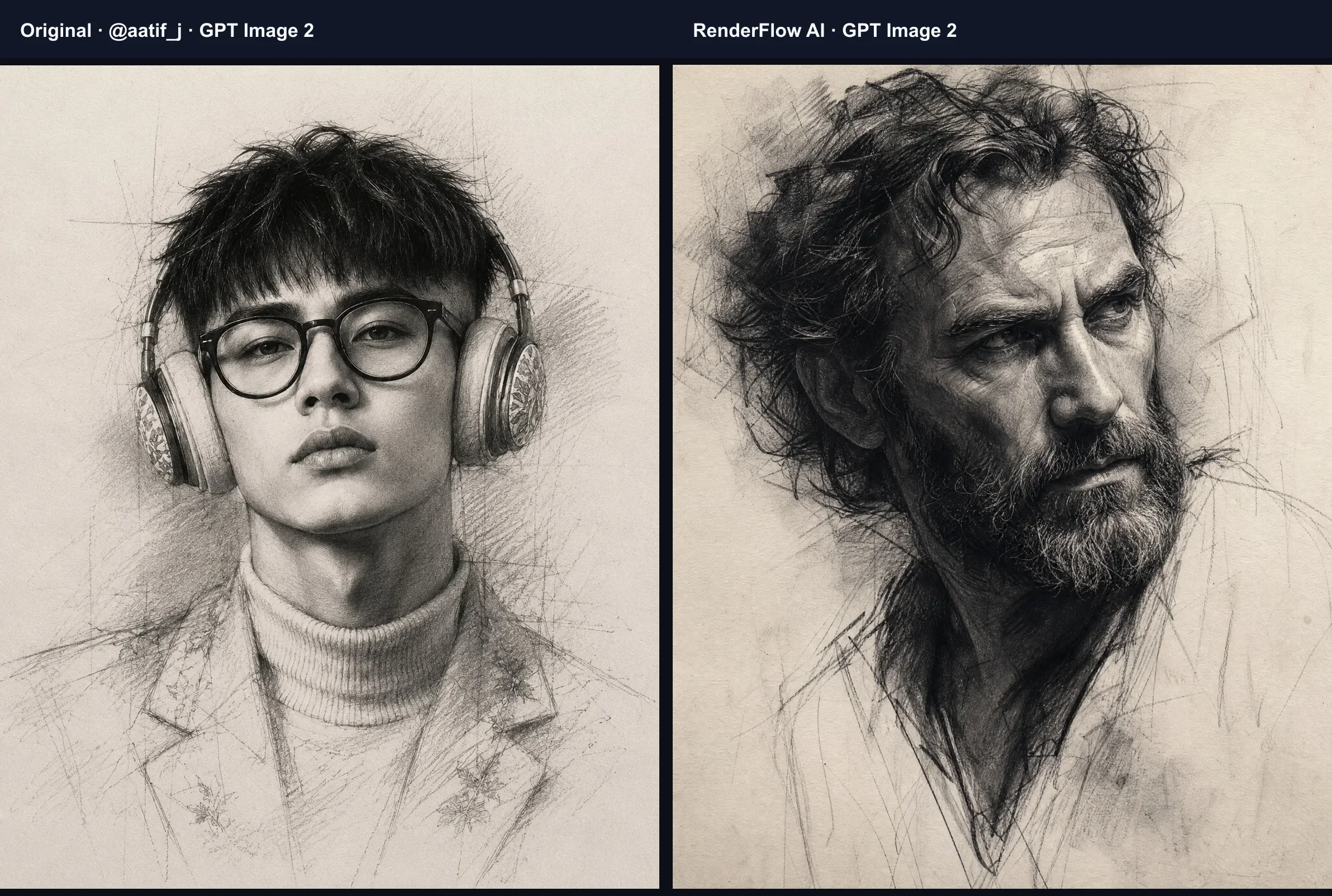
What happened: The original is smoother and more evenly finished, with glasses and headphones that give the sitter a clear identity. Our result uses deeper black focal masses, visible construction lines, unfinished clothing and background, graphite dust, and broken hatching. It follows the requested process and 85–90% completion idea more literally. However, the two subjects differ dramatically because the prompt never specifies who the sitter is.
Lesson: This is an excellent style prompt but an incomplete production prompt. For repeatable portraits, add one opening sentence defining age, gender presentation, hairstyle, facial hair, expression, pose, and accessories—or provide a permitted reference image.
5. Candid Luxury Mall Photo: Building a Believable Moment
Prompt and original image shared by @hey_am_cherry. We reran it with GPT Image 2 on RenderFlow AI.
An authentic candid lifestyle photograph inside an ultra-luxury shopping mall where an enormous floor-to-ceiling curved digital aquarium wall fills the elevator lobby with glowing blue light. Thousands of realistic jellyfish and tropical fish slowly drift behind transparent LED glass, casting beautiful reflections across polished white marble. A young Korean woman casually stands near the elevator while quietly scrolling through her smartphone with one hand and loosely holding a small luxury shopping bag in the other. She appears completely unaware of the breathtaking environment around her. Loose oversized cream T-shirt, black cycling shorts, white sneakers, effortless messy bun with soft face-framing strands. Captured naturally from a nearby passerby's perspective using a 50mm lens at chest height. Slightly obstructed framing with passing shoppers creating soft foreground blur. Elevator doors slowly opening behind her. Beautiful blue reflections on the floor and skin. Documentary street photography aesthetic, authentic candid moment, shallow depth of field, natural imperfections, premium smartphone realism, ultra-photorealistic.Why this is a good prompt: The scene has a deliberate contrast: an extraordinary aquarium environment and a person behaving as if it is ordinary. The prompt supports that story with camera height, passerby obstruction, foreground blur, opening elevator doors, and reflected blue light. Those details describe not just what is in the frame, but why the image should feel candid.
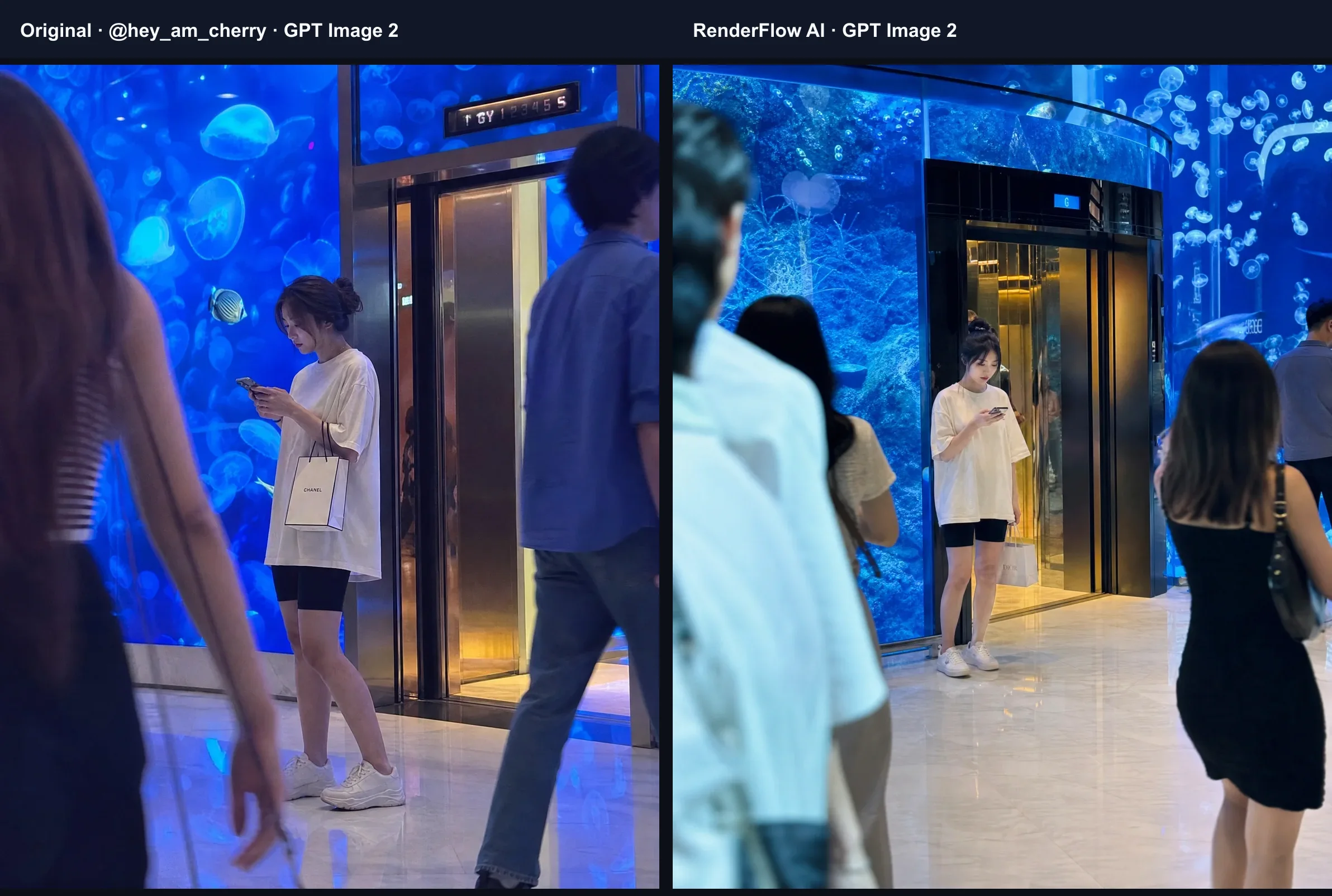
What happened: The original is tighter, more chaotic, and convincingly caught in passing, with an open elevator and intense electric-blue aquarium light. Our result makes the curved architecture, jellyfish, floor reflections, foreground shoppers, outfit, phone pose, and bag especially clear. It is more prompt-complete, but also a little more composed. Both images invent a fashion brand on the bag even though the prompt only asks for a “luxury shopping bag.”
Lesson: Models can equate “luxury” with recognizable branding. For commercial work, explicitly request “a plain unbranded shopping bag, no logos, no trademarks, and no readable text.”
6. Golden Rim-Light Portrait: A Focused Prompt With Repeatable Results
Prompt and original image shared by @Zyrellix. We reran it with Nano Banana 2 on RenderFlow AI.
A dramatic profile studio portrait of an attractive South Asian woman with long, voluminous layered hair featuring rich burgundy and mahogany highlights. Her head is tilted slightly upward with her eyes gently closed in a serene expression. Strong golden warm rim lighting illuminates her hair from behind, creating a glowing hair-halo effect with fine strand details. Soft matte makeup with dusty pink lipstick and a tiny subtle bindi on her forehead. Dark, warm moody background, cinematic studio lighting, shallow depth of field, highly detailed texture, 8k resolution, photorealistic.Why this is a good prompt: It locks the most recognizable parts of the portrait without overloading the model: profile orientation, upward head angle, closed eyes, layered burgundy hair, golden backlight, dark background, and a small set of facial details. The warm rim light has a clear physical purpose—it separates the hair from the background and exposes individual strands.
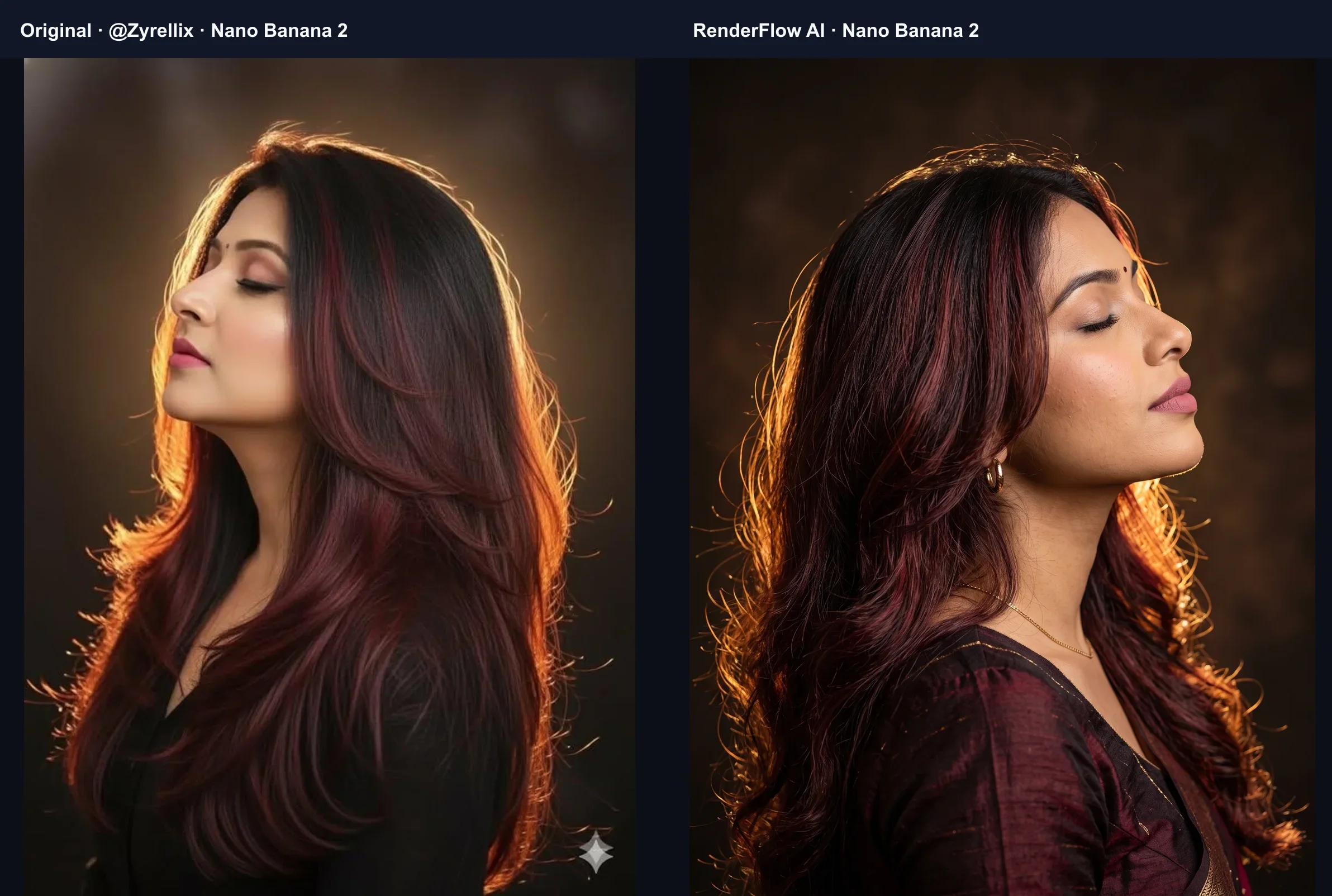
What happened: This is the closest same-model match in the set. Both images preserve the profile, closed eyes, elevated chin, burgundy-mahogany layers, gold hair halo, matte pink lips, bindi, and brown-black studio background. The original uses a slightly softer, more idealized finish. Our result shows more natural skin texture, a more distinct bindi, finer flyaway strands, and a stronger right-facing profile.
Lesson: When the goal is repeatability, focus on a small number of high-impact attributes that reinforce one another. Here, pose, palette, lighting direction, and hair styling all point toward the same portrait instead of competing for attention.
7. Midjourney Fantasy Prompt Tested on Seedream 5
Prompt and original Midjourney v8.2 image shared by @Cia0_exe. Because Midjourney is not available on RenderFlow AI, we tested the same wording with Seedream 5 on RenderFlow AI.
A small child sits nestled against the flank of a colossal spirit wolf with fur like drifting snow lit from within, both facing a valley of floating islands at twilight. Threads of pale blue light run beneath the wolf's fur like veins of starlight, and its breath scatters into glowing motes. Thousands of luminous seeds drift upward through the air around them. Ancient trees with bark of pale silver and canopies of soft cyan light arch overhead, roots hanging into open sky. A river of light winds through the valley far below, mirroring the aurora above. Deep indigo and teal palette pierced by warm gold bioluminescence, volumetric god rays through mist. Epic fantasy concept art, cinematic wide shot, painterly realism, intricate detail, ethereal and dreamlike, breathtaking scale --ar 16:9 --v 8.2 --hd --s 650 --chaos 12Why this is a good prompt: It builds scale by moving from an intimate relationship—the child against the wolf—to a valley, floating islands, ancient trees, and the sky. Repeated light motifs connect the whole frame: glowing fur, luminous seeds, a river of light, aurora, and warm bioluminescence. The prompt also specifies a widescreen composition and a limited indigo, teal, cyan, and gold palette.
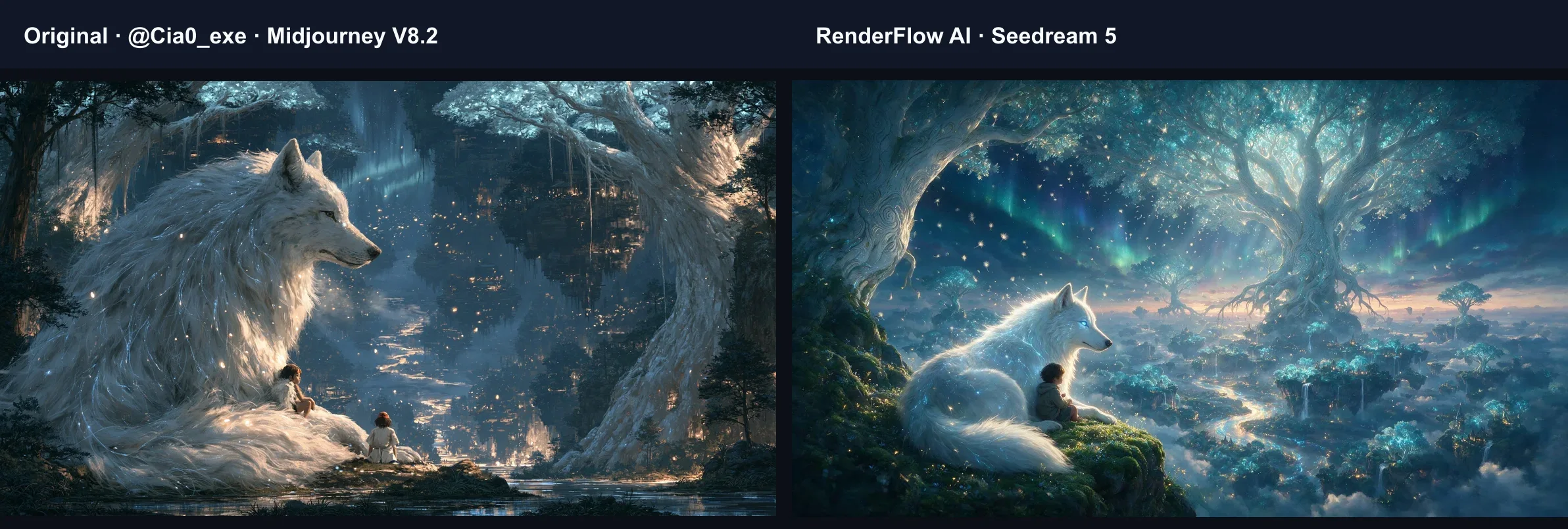
What happened: The Midjourney original gives the wolf greater visual dominance and a mysterious painterly finish, but it adds a second child and interprets the distant setting more like floating architecture. The Seedream 5 result follows “a small child” literally, places the child against the wolf, and renders clearer floating islands, luminous trees, aurora, and the river of light. It is a strong example of the core prompt surviving a model change.
Lesson: Separate portable scene language from platform controls. When moving this prompt away from Midjourney, remove --ar, --v, --hd, --s, and --chaos, then choose the aspect ratio in the generator interface. The descriptive portion is what carries the concept across models.
What These Prompt Tests Reveal
The best AI image prompt examples are not necessarily the longest. They make the important decisions visible and testable:
- Name the visual anchors. A moon, river, boats, flowers, and lantern reflections give the model a dependable scene structure.
- Describe relationships and actions. “One hand holds the book while the other adjusts the headphones” is more controllable than a list of accessories.
- Connect style to physical evidence. Graphite dust, paper fibers, erased highlights, and broken contours communicate “hand-drawn” more effectively than repeating “realistic sketch.”
- Control restraint explicitly. If you want negative space or minimal brushwork, say so; many models naturally add detail.
- Guard against unwanted content. Add “unbranded,” “one child,” “no readable text,” or another clear boundary when that distinction matters.
- Expect variation. A good prompt narrows the creative space. It does not lock every generation to one composition or identity.
Portrait Prompts: People and Characters
Creating compelling portraits with AI image prompts requires attention to facial features, expressions, and styling details.
Professional Portraits
Business Professional
"Professional headshot of a confident 35-year-old woman, warm smile, wearing navy blazer, soft studio lighting, shallow depth of field, shot with 85mm lens, high resolution"Creative Professional
"Portrait of artistic man with beard, thoughtful expression, wearing vintage leather jacket, creative studio background, dramatic side lighting, professional photography"Corporate Executive
"Executive portrait of distinguished woman in her 40s, authoritative yet approachable, grey suit, modern office background, natural lighting, business photography style"Artistic Character Portraits
Fantasy Character
"Ethereal elf warrior with silver hair, piercing blue eyes, intricate armor with Celtic designs, mystical forest background, magical lighting, fantasy art style"Steampunk Character
"Victorian inventor with brass goggles, leather coat, mechanical arm prosthetic, steampunk workshop background, warm amber lighting, detailed digital art"Cyberpunk Portrait
"Futuristic hacker with neon purple hair, cybernetic implants, leather jacket, city lights reflected in eyes, neon lighting, cyberpunk art style"Historical Portraits
Renaissance Style
"Noble woman in Renaissance dress, pearl jewelry, elaborate hairstyle, oil painting style reminiscent of Leonardo da Vinci, classical composition"1920s Glamour
"Elegant flapper in beaded dress, finger waves hairstyle, art deco jewelry, sepia tone, 1920s photography style, glamorous lighting"Victorian Gentleman
"Distinguished Victorian gentleman with top hat, pocket watch, formal coat, monocle, daguerreotype photography style, vintage sepia tones"Landscape and Nature Prompts
Natural scenes require AI art prompts that capture atmosphere, lighting, and environmental details.
Scenic Landscapes
Mountain Vista
"Majestic snow-capped mountain range, pristine alpine lake reflection, evergreen forest, golden hour lighting, landscape photography, wide angle lens"Coastal Scene
"Dramatic rocky coastline, powerful ocean waves, seabirds in flight, stormy sky with dramatic clouds, long exposure photography effect"Desert Landscape
"Vast sand dunes, camel caravan silhouette, orange sunset sky, minimal composition, warm color palette, travel photography style"Seasonal Scenes
Spring Meadow
"Wildflower meadow in full bloom, various colorful flowers, gentle rolling hills, soft morning light, butterflies, peaceful atmosphere"Autumn Forest
"Deciduous forest in peak fall colors, golden leaves falling, misty morning light filtering through trees, serene woodland path"Winter Wonderland
"Snow-covered pine forest, icicles on branches, soft snowfall, blue hour lighting, peaceful winter scene, high detail"Urban Landscapes
City Skyline
"Modern city skyline at twilight, skyscrapers with illuminated windows, river reflection, purple and orange sky, architectural photography"Historic Street
"Cobblestone European street, medieval architecture, warm street lamps, evening atmosphere, travel photography style"Futuristic Cityscape
"Sci-fi megacity with flying cars, neon advertisements, towering spires, cyberpunk aesthetic, dramatic perspective, concept art style"Fantasy and Imagination Prompts
Fantasy subjects allow for maximum creativity in AI image prompts:
Mythical Creatures
Dragon Scene
"Majestic ancient dragon with emerald scales, perched on mountain peak, breathing ethereal blue fire, stormy sky background, epic fantasy art"Unicorn Forest
"Pure white unicorn with spiral horn, galloping through enchanted forest, magical sparkles, soft ethereal lighting, fairy tale atmosphere"Phoenix Rising
"Magnificent phoenix with flames and golden feathers, rising from ashes, dramatic dark background, intense orange and red lighting"Magical Environments
Enchanted Library
"Vast magical library with floating books, spiral staircases, crystal orbs providing light, ancient tomes, mystical atmosphere"Crystal Cave
"Underground crystal cavern with massive amethyst formations, underground lake, ethereal blue lighting, fantasy environment"Floating Islands
"Sky islands connected by bridges, waterfalls cascading into clouds, floating rocks, surreal fantasy landscape, epic scale"Sci-Fi Scenes
Space Station
"Massive space station orbiting Earth, sleek metallic design, solar panels, stars in background, science fiction art style"Alien World
"Alien landscape with purple vegetation, twin moons in sky, strange rock formations, otherworldly atmosphere, concept art"Robot Companion
"Friendly humanoid robot with glowing blue eyes, sleek white design, helping humans, futuristic laboratory setting"Product and Commercial Prompts
Commercial applications require AI image prompts that emphasize quality and professional appeal:
Product Photography
Luxury Watch
"Swiss luxury watch on marble surface, dramatic side lighting, reflections, commercial photography style, high-end product photography"Gourmet Food
"Artfully plated gourmet dish, colorful ingredients, restaurant lighting, shallow depth of field, food photography, appetizing presentation"Tech Product
"Modern smartphone on clean white background, studio lighting, reflections on screen, minimalist commercial photography"Lifestyle Photography
Coffee Shop Scene
"Cozy coffee shop interior, people working on laptops, warm lighting, steam rising from coffee cups, lifestyle photography"Fitness Activity
"Athletic woman doing yoga at sunrise, mountain backdrop, peaceful expression, activewear, health and wellness photography"Home Interior
"Modern living room with minimalist furniture, natural lighting through large windows, plants, interior design photography"Architectural and Design Prompts
Architecture requires AI art prompts that emphasize structure, materials, and spatial relationships:
Modern Architecture
Contemporary House
"Modern minimalist house with glass walls, clean lines, surrounded by nature, architectural photography, golden hour lighting"Skyscraper Design
"Futuristic skyscraper with twisted design, glass and steel construction, city backdrop, architectural concept art"Historical Architecture
Gothic Cathedral
"Medieval Gothic cathedral interior, high vaulted ceilings, stained glass windows, dramatic lighting, architectural photography"Japanese Temple
"Traditional Japanese temple with pagoda roof, surrounded by cherry blossoms, peaceful garden, spring morning light"Interior Spaces
Luxury Hotel Lobby
"Grand hotel lobby with marble floors, crystal chandeliers, elegant furniture, warm ambient lighting, hospitality photography"Modern Kitchen
"Contemporary kitchen with white cabinets, marble countertops, stainless appliances, natural lighting, interior design"Abstract and Artistic Prompts
Abstract art with AI image prompts focuses on form, color, and emotion rather than realistic representation:
Color and Pattern
Fluid Abstract
"Abstract fluid art with flowing colors, organic shapes, gradient from blue to purple, smooth transitions, digital art style"Geometric Pattern
"Complex geometric mandala with intricate patterns, symmetrical design, gold and blue colors, detailed line work"Texture and Material
Organic Texture
"Close-up macro photography of water droplets on leaf surface, natural texture, soft focus background, fresh green colors"Industrial Materials
"Weathered metal surface with rust patterns, industrial texture, dramatic lighting, abstract composition"Advanced Prompt Writing Techniques
Using Negative Prompts
Negative prompts tell the AI what to avoid:
Prompt: "Beautiful portrait of young woman"
Negative: "blurry, low quality, distorted, extra limbs, bad anatomy"
Weighted Keywords
Emphasize important elements:
"(Beautiful woman:1.3), sitting in garden, (soft lighting:1.2), professional photography"Style Mixing
Combine different artistic approaches:
"Photorealistic portrait in the style of Renaissance painting, modern lighting techniques"Technical Camera Terms
Add photographic authenticity:
"Shot with Canon 5D Mark IV, 85mm lens, f/1.4 aperture, natural lighting, shallow depth of field"Platform-Specific Prompt Tips
Different AI generators respond better to specific prompt styles:
RenderFlow AI (Multiple Models)
- Best practice: Choose the appropriate model first, then craft prompts
- GPT Image 2: Responds well to precise layout, material, and text instructions
- Nano Banana 2: Strong for detailed natural-language prompts and photorealistic scenes
- Seedream 5: Strong for atmospheric illustration, concept art, and cinematic compositions
- Tip: Use model-specific prompt optimization
Midjourney Style
- Artistic terms: “cinematic,” “hyperrealistic,” “detailed”
- Aspect ratios: Add “—ar 16:9” for landscape format
- Style parameters: “—stylize 750” for more artistic interpretation
DALL-E 3 Approach
- Natural language: More conversational prompt style
- Context: Provide background information and context
- Safety: Avoid potentially sensitive content
Stable Diffusion
- Technical precision: Detailed technical specifications work well
- Community models: Reference specific trained models
- Advanced parameters: CFG scale, steps, sampling method
Common Prompt Mistakes to Avoid
Overly Complex Descriptions
Problem: “A beautiful woman with long flowing hair wearing a red dress standing in a garden full of roses under a rainbow after rain with butterflies and birds singing”
Better: “Portrait of woman in red dress, garden setting with roses, soft natural lighting”
Contradictory Elements
Problem: “Bright sunny day with dark storm clouds and heavy snow”
Better: “Dramatic sky with mix of sunlight and storm clouds, winter landscape”
Vague Style References
Problem: “Make it look cool and awesome”
Better: “Cyberpunk aesthetic with neon lighting, futuristic atmosphere”
Missing Context
Problem: “A dog”
Better: “Golden retriever sitting in sunny park, professional pet photography, shallow depth of field”
Iterating and Refining Prompts
Successful AI image prompt creation is an iterative process:
Step 1: Basic Generation
Start with a simple, clear prompt:
"Mountain landscape at sunset"Step 2: Add Details
Enhance with specific elements:
"Snow-capped mountain range at golden hour sunset, dramatic clouds"Step 3: Technical Improvement
Include quality and technical terms:
"Majestic snow-capped mountain range at golden hour sunset, dramatic cloud formations, landscape photography, wide angle lens, high resolution"Step 4: Style Refinement
Add artistic direction:
"Majestic snow-capped mountain range at golden hour sunset, dramatic cloud formations, landscape photography style of Ansel Adams, wide angle lens, high resolution, dramatic lighting"Building Your Prompt Library
Successful AI art prompt creation benefits from organization:
Categorize Successful Prompts
- Portraits: Professional, artistic, character
- Landscapes: Natural, urban, fantasy
- Products: Commercial, lifestyle, technical
- Abstract: Color studies, patterns, textures
Document Variables
Track what works:
- Model used: Different models prefer different styles
- Keywords that work: Build a vocabulary of effective terms
- Style references: Note artistic styles that produce good results
- Technical terms: Camera and lighting terminology
Create Template Prompts
Develop reusable frameworks:
Portrait Template:
"[Age/description] [gender] with [hair], [expression], wearing [clothing], [setting], [lighting], [photography style]"Landscape Template:
"[Type of landscape], [weather/time], [specific elements], [artistic style], [technical specifications]"The Psychology of AI Prompt Writing
Understanding how AI models process language helps create better AI image prompts:
Specificity vs. Creativity
- Specific prompts: Produce predictable, targeted results
- Abstract prompts: Allow for more creative AI interpretation
- Balance: Mix specific requirements with creative freedom
Cultural and Historical Context
- Reference periods: “Victorian,” “Art Deco,” “Renaissance”
- Cultural styles: “Japanese minimalism,” “Scandinavian design”
- Art movements: “Impressionist,” “Surrealist,” “Pop Art”
Emotional Language
- Mood descriptors: “Serene,” “dramatic,” “mysterious,” “joyful”
- Atmosphere: “Cozy,” “epic,” “intimate,” “grand”
- Energy: “Dynamic,” “peaceful,” “intense,” “calm”
Advanced Applications for AI Image Prompts
Brand Consistency
Create cohesive visual content:
"[Brand style] + [specific request] + [consistent elements]"
Example: "Minimalist modern style product photo, clean white background, soft shadows, professional lighting"
Storytelling Sequences
Develop narrative through images:
Scene 1: "Character introduction in home environment"
Scene 2: "Character discovering mysterious object"
Scene 3: "Character's transformation or revelation"
Concept Development
Iterate through design concepts:
Version A: "Modern house with glass walls"
Version B: "Modern house with glass walls and natural stone accents"
Version C: "Modern eco-house with glass walls, natural stone, and green roof"
Measuring Prompt Success
Evaluate your AI art prompts systematically:
Quality Metrics
- Accuracy: Does the image match your description?
- Composition: Is the layout visually appealing?
- Technical quality: Sharp focus, appropriate lighting?
- Style consistency: Does it match your intended aesthetic?
Iteration Tracking
- Version comparison: Save multiple generations for comparison
- Prompt evolution: Document how prompts improve over iterations
- Success patterns: Identify what makes prompts work
Future of AI Image Prompting
AI image prompts continue evolving with technology:
Emerging Trends
- Natural language improvement: AI better understands conversational prompts
- Multimodal inputs: Combining text, images, and other data types
- Real-time refinement: Adjusting prompts as images generate
- Context awareness: AI remembering previous requests and preferences
Advanced Features
- Prompt auto-completion: AI suggesting prompt improvements
- Style transfer prompts: Applying styles from reference images
- Collaborative prompting: Multiple people refining prompts together
- Voice-to-image: Speaking prompts instead of typing
Conclusion: Mastering AI Image Prompts
Effective AI image prompts are the foundation of successful AI art creation. By understanding prompt structure, practicing with diverse examples, and iterating on your approach, you can consistently generate stunning, professional-quality images.
Remember these key principles:
- Be specific: Clear, detailed descriptions produce better results
- Use technical terms: Photography and art terminology improves quality
- Iterate and refine: Perfect prompts develop through experimentation
- Build a library: Save and organize successful prompts for reuse
- Stay current: New AI models may require different prompt approaches
The examples and techniques in this guide provide a solid foundation, but the best way to master AI art prompts is through practice and experimentation.
Ready to put these AI image prompt techniques into action? Start creating with RenderFlow AI → and access multiple cutting-edge AI models to test your new prompt writing skills. With the right prompts and the right tools, you can generate any image you can imagine.
Whether you’re creating content for business, exploring artistic expression, or solving design challenges, mastering text-to-image prompts opens up unlimited creative possibilities. The only limit is your imagination—and now you have the tools to express it perfectly.
Frequently Asked Questions
What makes a good AI image prompt?
A strong AI image prompt clearly describes the subject, visual style, setting, lighting, composition, and quality details instead of relying on vague one-word instructions.
Can I reuse the same prompt across Midjourney, Flux, DALL-E, and Imagen?
Yes, the same prompt structure usually works across major text-to-image models, though each model may respond better to slightly different style, aspect ratio, or camera-language details.
How do I improve weak AI image results?
Add more specific subject details, clarify the style and lighting, remove conflicting instructions, and iterate one change at a time so you can see what improves the output.
Will the same AI image prompt produce the same picture twice?
No. Image generation includes randomness, so even the same prompt and model can produce different subjects, framing, and details. A well-structured prompt improves consistency without guaranteeing an identical image.
Related Articles
AI Art Generator: The Complete Guide to Creating Digital Art with AI in 2026
Learn how to create stunning digital art with AI art generators. Explore styles, techniques, best platforms, and pro tips for AI-generated artwork.
14 min read
How to Generate AI Images: Complete Beginner's Guide (2026)
Learn how to generate AI images from text with this complete beginner's guide. Step-by-step instructions, tips, and examples for creating stunning AI art in 2026.
10 min read
6 Best Free AI Image Generators in 2026 (No Credit Card)
Compare six free AI image generators by sign-up rules, credit limits, model choice, and upgrade path, including a local option without platform credits.
10 min read
About the Author
AI Image & Video Generation Experts